You know which workflow could use AI. You are not giving a chatbot the keys.
I build production AI agents inside your AWS account: scoped IAM your security team can read, human approval on every consequential action, and an audit trail in an account you own. Bring one workflow, not an AI wish list. The reference deployment runs three agents that a non-technical operator uses every day.
Deploy a production AI agent inside your own AWS account with scoped tools, human approval, observability, and audit evidence. Based in Naples, Florida, serving clients nationwide.
Who custom AI agent development is for
Who this is for
- An owner or operator can name a recurring workflow: incident triage, content operations, cost analysis, order support, reporting: that consumes senior attention every week.
- Your systems already run on AWS, or you want the agent governed inside an AWS organization you control.
- The useful context lives across real systems: a CMS, ERP, commerce platform, repositories, observability, documents, or internal APIs.
- You want one narrow capability working in production before funding a broad transformation program.
Who this is NOT for
- You only need a marketing-site chatbot or a generic document Q&A tool. Buy the commodity product; custom engineering will not improve the economics.
- You want an innovation workshop with no operational workflow, system owner, or route to production.
- You expect unrestricted autonomy on day one. Access grows capability by capability; it is not granted as a blanket permission.
- The source data is unreliable and the underlying workflow has no system of record. Fix that foundation first, then automate it.
Where this engagement starts
Why most business AI never reaches production
Most AI pilots fail after the demo. The model can answer a question, but it does not know the business's actual systems, cannot verify its own work, and has no safe path to take action. The result is another chat window that produces suggestions while people still do the operational work by hand.
The opposite failure is just as common: broad credentials, vague instructions, and an agent that can change a live system without a dependable approval or audit trail. That is not useful autonomy. It is unbounded operational risk.
A production agent needs the same engineering discipline as any other critical system: a reliable source of context, explicit tools, capability-specific permissions, verification after action, and a human decision at the points where the cost of being wrong is high. The model matters. The operating system around it matters more.
See the operating model
One approved request becomes a live production change
This 63-second production walkthrough follows one feature request through repository inspection, visual mockups, a scoped approval, a verified pull request, deployment, the live result, and the audit evidence left inside the client's AWS account.
Read the visual transcript
00:00 - The live Fine's Gallery storefront shows product dimensions fixed in US units. 00:09 - The operator asks the agent in Slack to design and implement an imperial/metric preference without breaking existing product pages. 00:17 - The agent inspects the application and returns a proposed solution with visual mockups for review. 00:23 - The agent prepares the implementation and presents the exact external action for human approval. Nothing ships until the operator approves that scoped plan. 00:33 - The approved change becomes a pull request with modified files and verification evidence, then merges and deploys through the existing delivery path. 00:45 - The production storefront displays the completed unit toggle across multiple product types. 00:55 - CloudWatch records the request, tool activity, approval, and response inside the client's AWS account, leaving an auditable trace of the run.
Outcomes
What a production AI agent deployment delivers
- 6 weeks to productionReference deploymentSource: Fine's Gallery repository history and runtime deployment
- Three agent lanesProduction agent lanes todaySource: Fine's Gallery deployment: engineering, content, and sales runtimes
- Human-approvedExternal actionsSource: Tool-boundary approval records
- Client-controlledRuntime, repositories, and logsSource: Client AWS organization
- No long-lived keysAWS delivery credentialsSource: GitHub OIDC, IAM authentication, and STS
- End-to-end traceRequests, tools, approvals, and resultsSource: Production audit records
Deployed Production Agents
Agent lanes running in production today
This is not a catalog of possibilities. These are the three agent lanes deployed and working right now, in client-owned AWS organizations, each with its own runtime, credentials, approval gate, and audit trail. New lanes are added the same way: one governed capability at a time.
Engineering agents
Production investigation across ECS, alarms, logs, and recent changes through structurally read-only access. Cost analysis from your own billing data. Code changes prepared in disposable clones and delivered as draft pull requests with verification evidence. Included with every Platform Build: the agent does the investigating, evidencing, and drafting, so routine maintenance shrinks to reviewing an evidenced pull request, work any qualified engineer can take on. Running today for Fine's Gallery and for Conti Digital's own infrastructure.
Content, SEO, and social agents
Draft-first CMS operations behind a fail-closed field policy. A closed-loop SEO practice on live Search Console, GA4, and Semrush data with measured, recorded outcomes. Social publishing to Pinterest, Instagram, Facebook, and Google Business Profile from real CMS records. At Fine's Gallery, this lane is driven daily by a non-technical operator.
Sales support agents
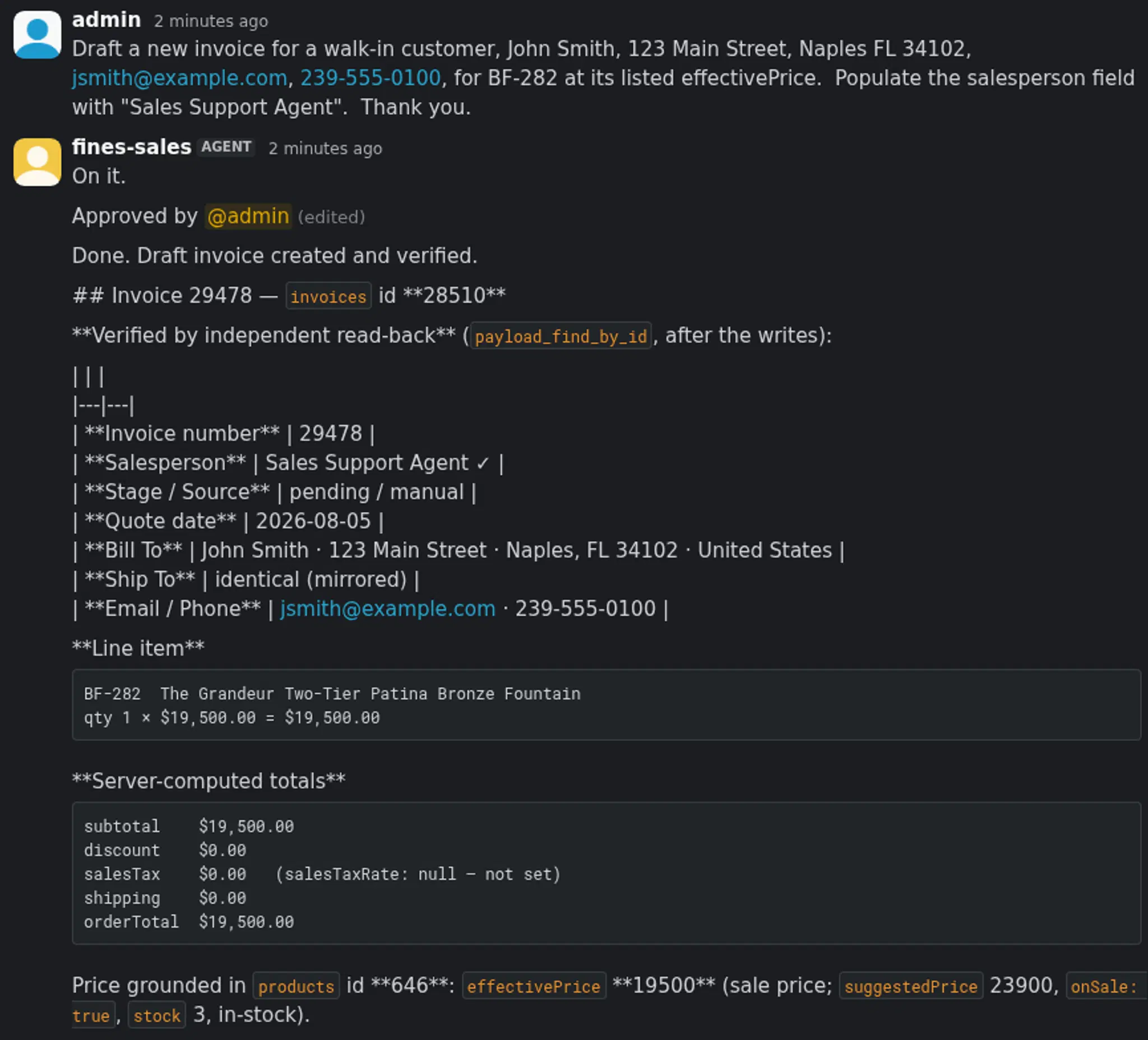
A production sales lane that briefs staff before customer calls from a read-only mirror of decades of company records, drafts invoices with the platform's real numbering and rate rules, prepares mailbox replies it structurally cannot send, and requests payments only through the platform's own issuing flow. Three writable record types out of dozens, field-allowlisted, every write behind a human approval.
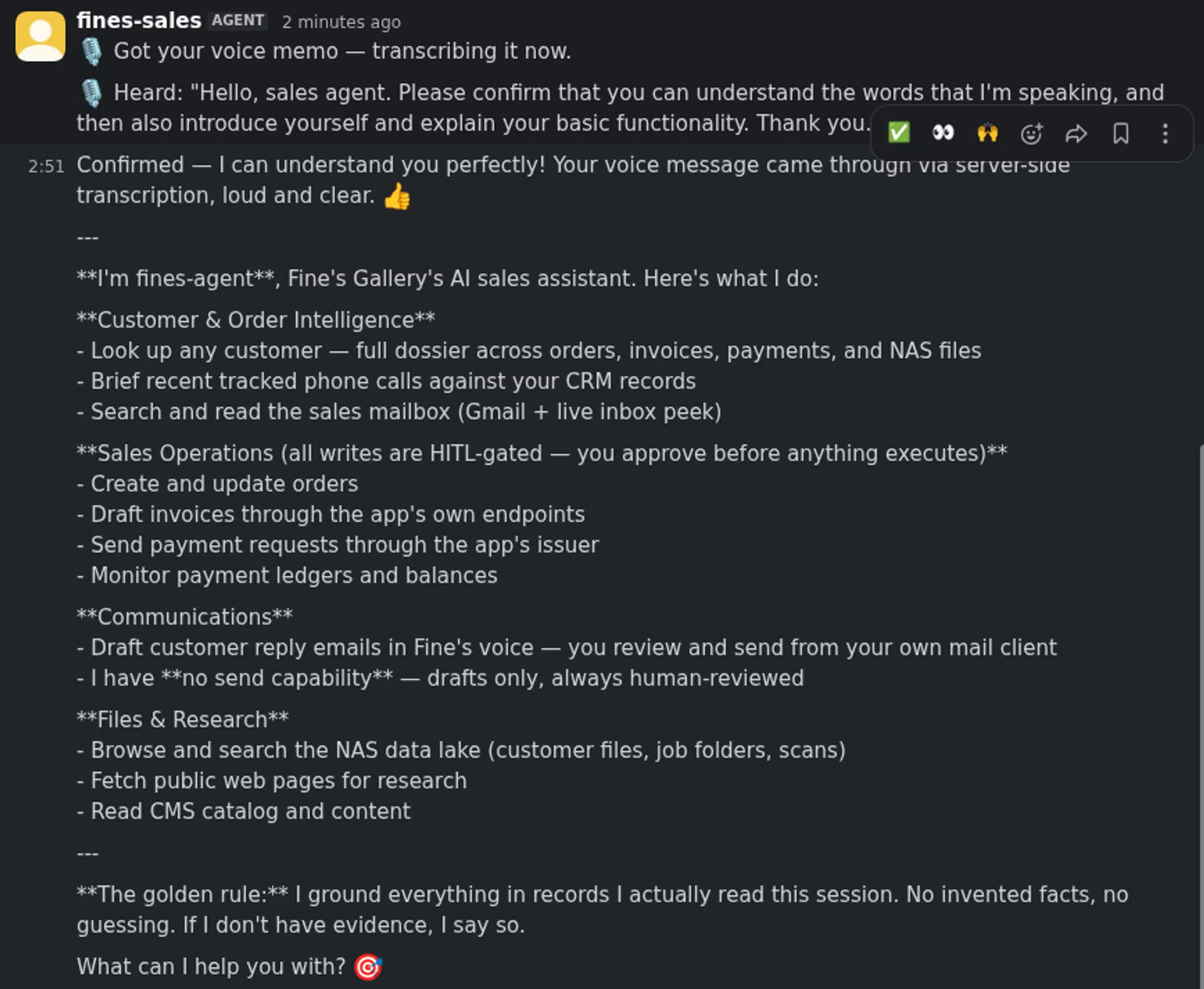
Voice-operated via Slack
Staff dictate requests as Slack voice memos. Audio is transcribed server-side with Amazon Transcribe inside the client's account, echoed back for confirmation, and handled like any typed request, approvals included. Transcripts are never logged, and a failed transcription fails loudly instead of guessing.
Content lane in production
What a governed content agent actually returns
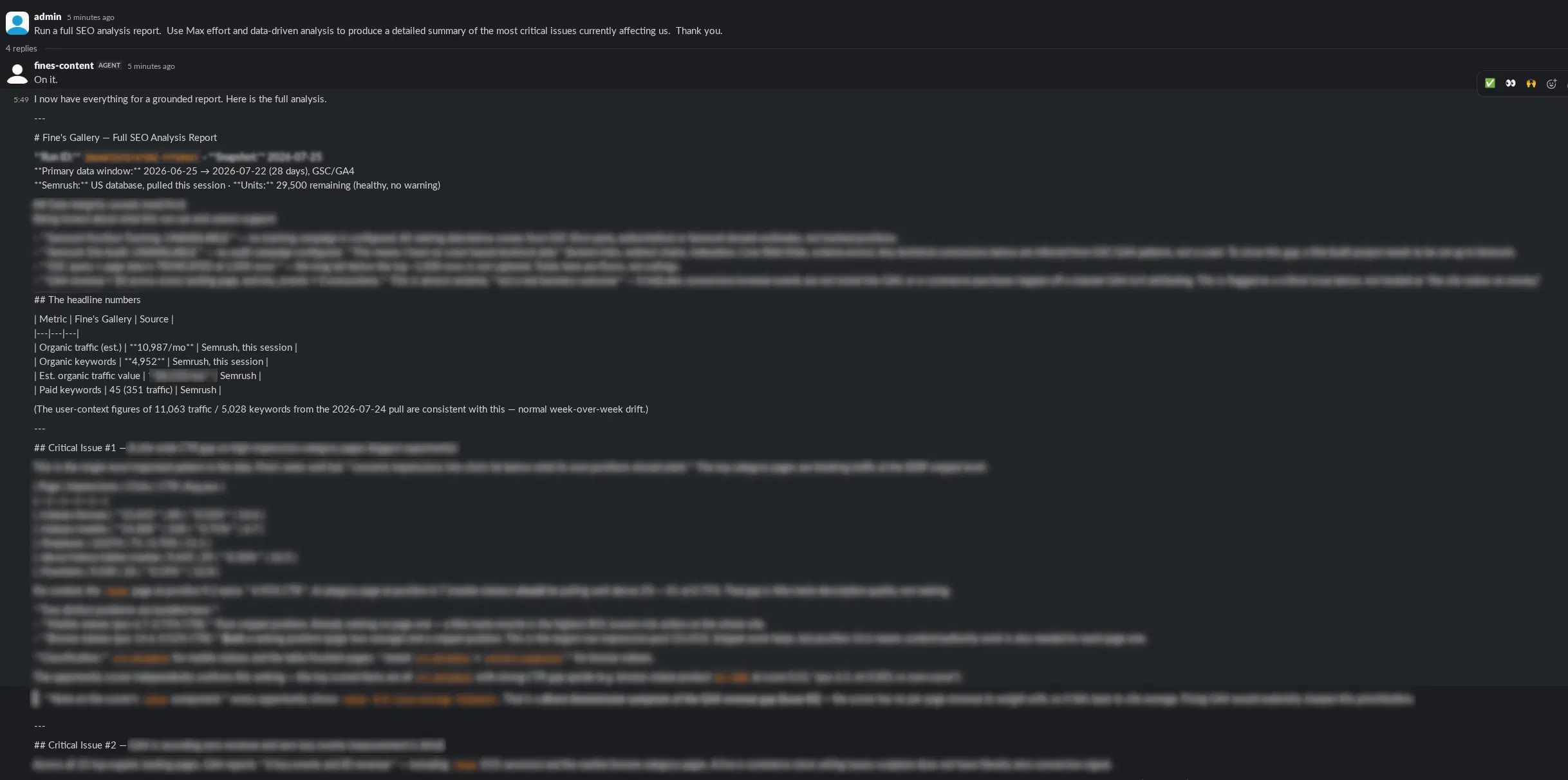
A non-technical operator asks for an SEO analysis in plain language. The agent answers with its run identifier, snapshot date, the exact Search Console and GA4 window, a live Semrush pull with remaining research budget, and ranked issues, stating data-integrity caveats before any conclusion. Every recommendation it then acts on still passes through a human approval.
Content lane in production
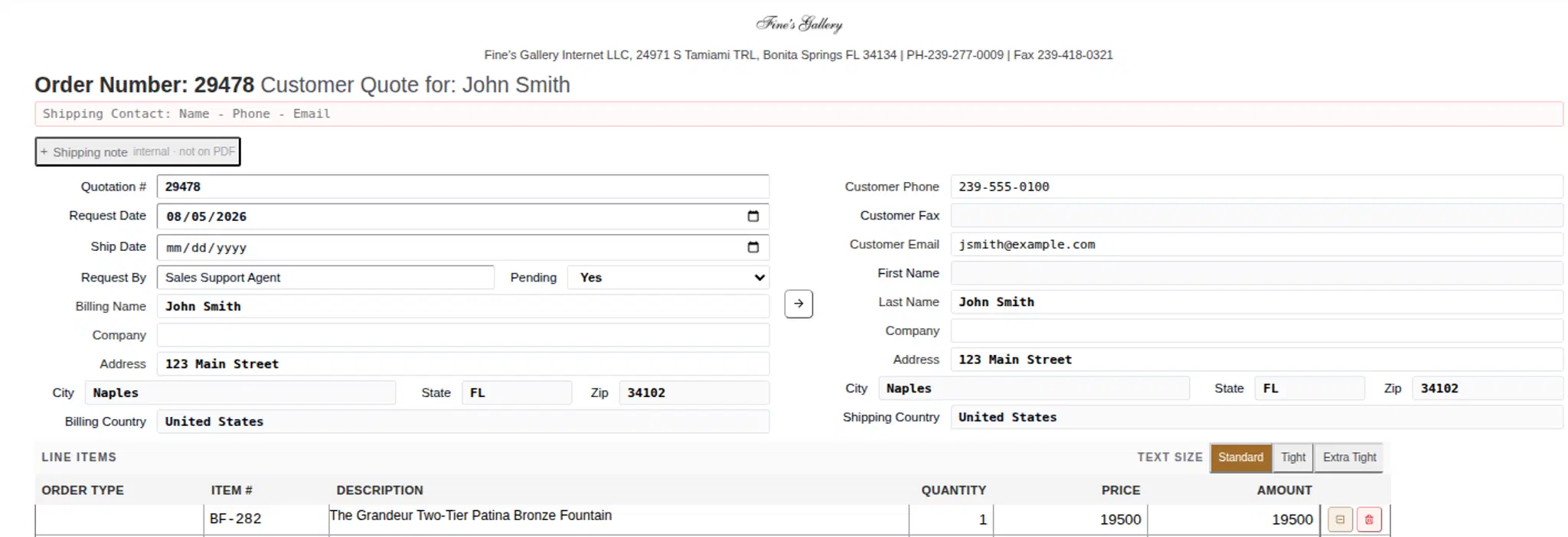
Approved once, published everywhere, logged completely
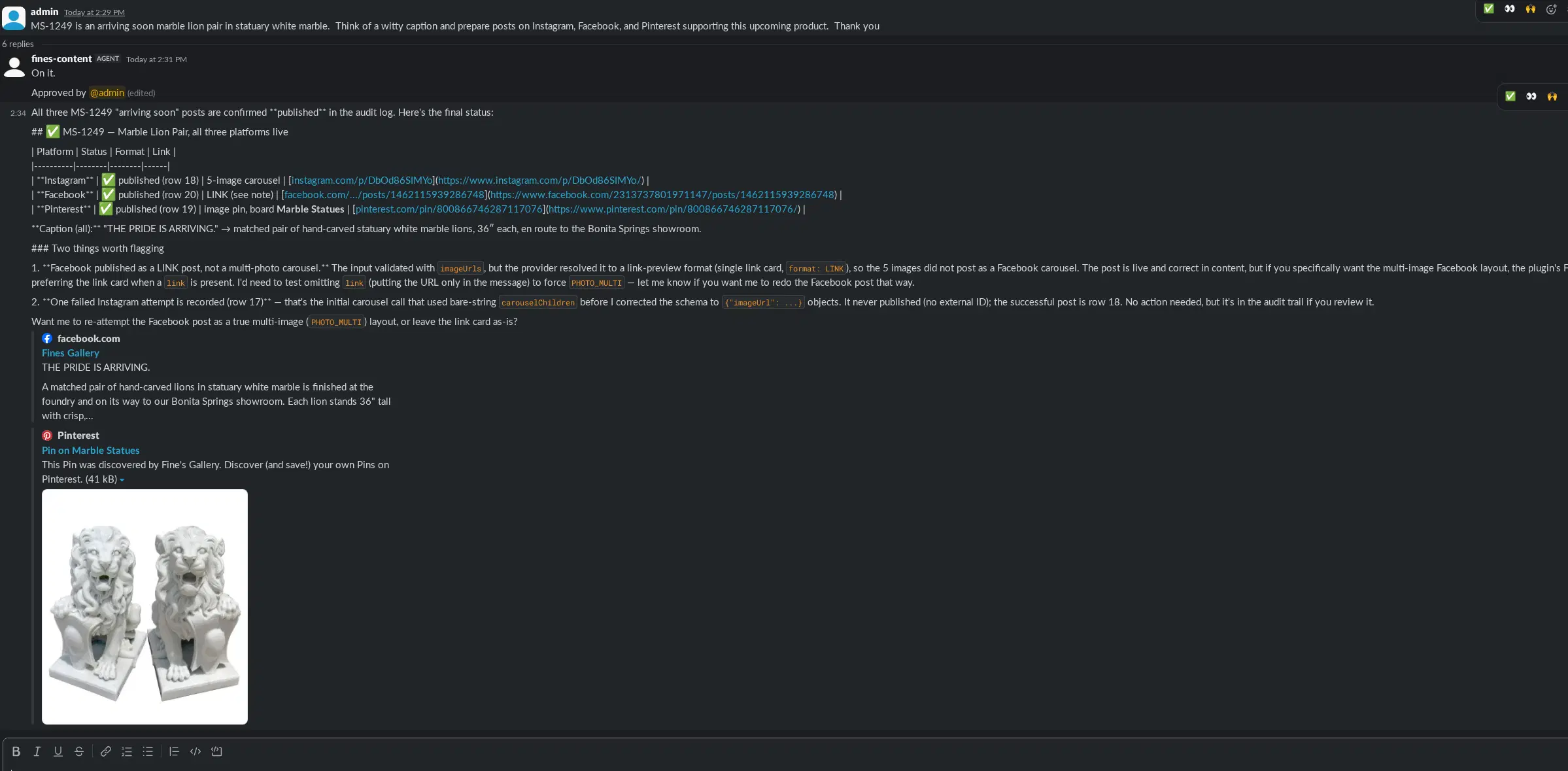
The same operator asks for social posts supporting an arriving product. The agent drafts, waits for a human approval, publishes to three platforms, returns the live links with their audit rows, and flags both an imperfect format resolution and an earlier failed attempt rather than quietly moving on.
Delivered to the Ownership Standard
Agents, permissions, infrastructure, and audit history land in accounts you own and meet the Ownership Standard. The evaluation framework is public: six questions to ask before you sign any AI engagement.
Run the six questions against the operating proposal
One alternative is a vendor-hosted managed AI service: billed monthly, running in the vendor's accounts on the vendor's keys. Ongoing management can be valuable, but custody of the runtime is a separate decision. Before you sign one, run the six questions against it. Who owns the account the agent runs in? Whose secrets manager holds the credentials it uses? What happens if the operating relationship changes? What are the infrastructure and model costs versus the engineering fee? What maintenance, evaluation, and incident work happens after launch? Can your engineer read the code that decides what the agent is allowed to do?
A vendor with good answers deserves the meeting. Ongoing operation is real engineering work: model and dependency changes, evaluation, monitoring, incidents, security, and new capabilities. The deciding question is whether the service continues work on a system you control or whether stopping the service deletes the system itself. Everything on this page is built so that my answers to those six questions are boring, and the Ownership Standard is where they are written down and signed.
The audit trail, produced
Every request the agent handles is a record you own
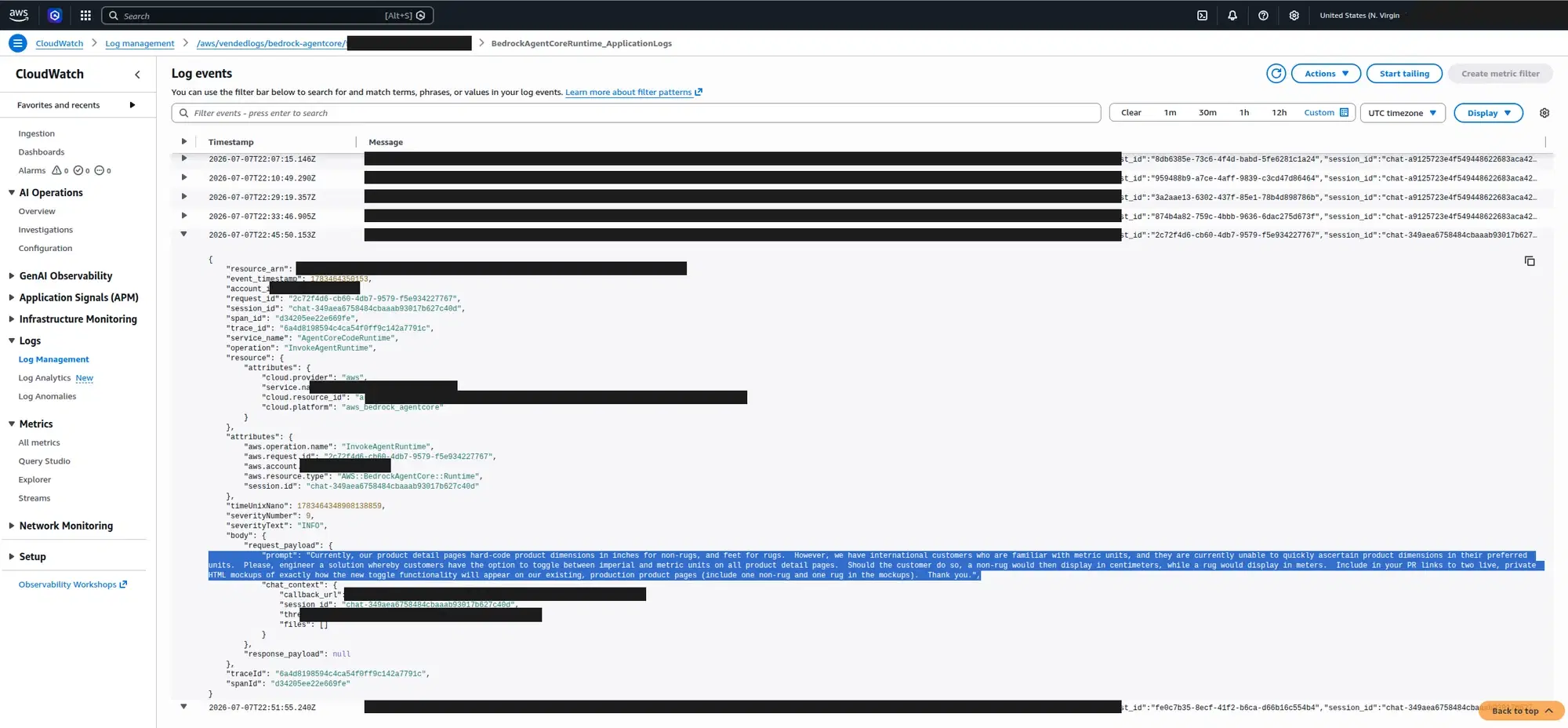
A real operator request, captured as a structured event in the client's own CloudWatch: the prompt in plain language, severity, session, and trace identifiers intact. This is what governed means in practice. The log group lives in your account while I continue operating the system, and it exists for every invocation. Ask any vendor quoting ongoing AI operations to show you the equivalent operating record.
The entry path
The Agent Architecture Sprint is $10,000, credited in full against the subsequent build when I perform the build. Agent Production Builds start at $25,000. Pricing is published.
Every sprint includes a vendor dependency audit: your current stack, scored in writing against the six questions and the Ownership Standard.
The approach
How an AI agent engagement runs, from sprint to production
Start with one operational workflow where faster investigation or execution has obvious value. Define the trust boundary before granting access, ship a working slice in the client's AWS organization, and expand capability only when the evidence supports it. Amazon Bedrock keeps the model layer selectable: the system can use whichever available model best fits the task, latency target, and cost envelope without rebuilding the integrations around it.
Agent Architecture Sprint: $10K
Three weeks to map the workflow, systems, data, failure modes, approval points, and expected operating cost. The deliverable is a written architecture decision document, not a slide deck or a speculative prototype. If an agent is the wrong answer, the document says so before build money is spent.
Agent Production Build, from $25K
A production build starting at $25K puts one high-value workflow into production: the runtime, business-specific tools, required integrations, scoped access, and the operator experience in Slack or the interface your team already uses.
Govern and verify
External actions receive explicit approval gates where needed. Tool calls are logged. High-impact results are verified against the live system before the agent reports success. Access is narrow by default and can expand per capability as trust and requirements grow.
Operate, maintain, and extend
The agent, infrastructure, source code, runbook, and deployment pipeline remain in your organization. I can continue operating, maintaining, evaluating, and extending the agent under Ongoing Platform Engineering, or work beside an internal engineer. Client control and delegated operation coexist.
What you receive in a custom AI agent build
- A written architecture decision document covering the workflow, capability map, data boundaries, risk register, approval model, and operating-cost estimate
- A single-tenant production agent deployed inside your AWS organization
- A Bedrock model-selection and routing policy that can change as model availability, quality, latency, and cost change
- The agreed first workflow and its business-specific integrations, not a generic chat shell
- Capability-specific IAM, approval boundaries, and verification rules tied to the actual cost of failure
- Structured tool-call audit logs, traces, alarms, and a runbook for investigating agent behavior
- Infrastructure as code, CI/CD through GitHub OIDC, and no long-lived AWS credentials in the delivery path
- Source code, deployment pipeline, and operational documentation delivered into repositories and accounts you control
What clients say
“Mr. Peter, as our technology partner, built our entire commerce and operations platform from the ground up on AWS. It runs our website, our orders, our invoicing, our payments, everything. Migrating to the new system was seamless, with no interruption or data loss. Peter is honest, a strong communicator, and when something needs attention, he takes care of it fast. I trust him with the most important systems in my company. Highly recommended.”
FAQ
AI agent development questions buyers ask first
The runtime, IAM, logs, source code, and deployment pipeline live in your AWS organization and repositories. Model calls go through Amazon Bedrock under your account. If the engagement ends, the system does not disappear behind a vendor login; you retain the deployed capability and the code that operates it.
Any model made available through Amazon Bedrock can be evaluated for the workload. The integrations, permissions, and business tools do not depend on one model family. A routing layer can select different models by task, or the deployment can standardize on one model and change it later without rebuilding the operating system around the agent.
Yes, and the reference deployment does. One codebase and one container image deploy as multiple agents, each with its own runtime, IAM role, Slack identity, approval store, and memory. A single capability manifest drives both the code that registers each agent's tools and the infrastructure that attaches each capability's permissions, so an agent's abilities and its access cannot drift apart. The content agent has no path to repositories or infrastructure; the engineering agent has no credential for the live CMS. That isolation is what makes it safe to give different teams different agents.
Yes. This is now a shipped lane, not a roadmap item. The reference deployment's sales support agent reads customer and order records, briefs staff before calls from a read-only mirror of the company's document archive with sensitive trees excluded at the permission layer, and drafts invoices through field-allowlisted tools. Customer identity records stay read-only, payment links are minted only by the platform's own issuing endpoint, and every write stops at a human approval in Slack. Record-level access is always built this way: minimum fields, explicit logging, and a human on the consequential path.
The architecture assumes it will be wrong sometimes. Reversible local work stays isolated. External changes can require approval. High-impact tools return verification evidence from the live system before the agent reports success. Every tool call is attributable to a request, session, input, output, and: when gated, an approver, so the question is not whether mistakes are possible; it is whether their blast radius and recovery path were designed in advance.
Usually, if the system exposes a stable API, database boundary, event stream, or command-line interface. The reference deployment integrates AWS operations, Payload CMS, GitHub, CloudWatch, and Cost Explorer. Each new integration is packaged as a separately testable capability with its own instructions and permissions.
The Agent Architecture Sprint runs for three weeks. A focused Agent Production Build is usually six to eight weeks after that; integration complexity and access review can change the schedule. The Fine's Gallery reference deployment went from first scaffold to production in six weeks.
The fixed-scope Agent Architecture Sprint is $10,000. Focused Agent Production Builds start at $25,000 and are quoted from the sprint's architecture and risk register. Model usage and AWS infrastructure are paid directly through your AWS account; there is no hidden per-seat agent platform fee from Conti Digital.
Bring one workflow that consumes senior attention and the systems it crosses. A free 30-minute consultation is enough to decide whether it belongs in the $10K Agent Architecture Sprint. If the problem is actually bad process, unreliable data, or missing system boundaries, I will say that before proposing an agent.
Yes. Conti Digital is based in Naples, Florida and works with clients nationwide. Businesses in Naples, Bonita Springs, Fort Myers, and the rest of Southwest Florida get a local AI consultant; the AWS delivery model also supports distributed operators and engineering teams anywhere in the United States.
AI automation follows a defined trigger and sequence. An AI agent can interpret context, choose among approved tools, gather evidence, and decide which permitted step to take next. In production, that flexibility needs explicit permission scopes, human approval for consequential actions, verification, observability, and a complete execution record.
Many AI agencies host the agent on their platform and retain the runtime, control plane, or operational data. This engagement deploys the agent into your own AWS account. You own the code, infrastructure, logs, tool contracts, and approval boundaries, while model access can remain replaceable through Amazon Bedrock.
Yes. A voice memo recorded in Slack is acknowledged, transcribed server-side with Amazon Transcribe inside the client's account, echoed back as text for confirmation, and then processed exactly like a typed request, human approvals included. Audio is staged in a private encrypted bucket for seconds and deleted, transcript text is never written to logs, and a clip that cannot be transcribed produces a plain-language failure rather than a guess.
Related work
See Client-Owned AI Agents & Integrations in production
Fine's Gallery: AI Operations Agents for Real Work
What began as a single AI operations agent inside Fine's Gallery's AWS organization is now three: an engineering agent, a content agent, and a sales support agent, built from one codebase but isolated down to their runtimes, credentials, and Slack channels. The sales agent works the commercial back office: it reads the company's document archive, briefs staff before customer calls, drafts invoices and replies, and requests payments through the platform's own issuing flow. Staff can now talk to the agents literally: a voice memo dropped in Slack is transcribed server-side and handled like any typed request. Every consequential action still stops at a human approval.
Fine's Gallery Platform Modernization
Fine's Gallery began with a catalog-only website: customers could browse thousands of high-value products, but they could not complete payment online. Sales happened through staff, phone, email, showroom conversations, FileMaker, and disconnected vendor tools. I built the first transactional commerce and operations platform inside the client's own AWS Organization. It now supports millions in annual revenue, including six-figure monthly commerce volume; migrated 28,062 invoices and more than 20 years of operating history without loss or duplicate invoice numbers; and cut over with zero downtime. I continue to operate, maintain, and extend the AWS infrastructure and application after launch.
Read more
Read more about Client-Owned AI Agents & Integrations
The Sovereign AI Agent: Production Ops in an Account You Own
A production pattern for client-owned AI agents on AWS, now running at Fine's Gallery with scoped tools, human approval, audit evidence, and no hosted-agent lock-in.
Building a Production Social Media Plugin for Payload CMS
A production Payload CMS social media plugin for Pinterest, Instagram, Facebook, and Google Business Profile, with scheduling, AI-safe tools, and 1,146 tests.
Related services
Other services connected to Client-Owned AI Agents & Integrations
Bring the workflow, not an AI wish list
Describe the recurring operational work, the systems it crosses, and what a wrong action would cost. I will respond with whether it fits an Agent Architecture Sprint, needs prerequisite systems work, or is better served by an existing product.
Pressure-test the platform decision before you commit budget.
Schedule a complimentary 30-minute consultation to align on objectives, stress-test your architecture, and leave with a concrete set of recommendations. No obligation, no sales pitch. Just actionable technical guidance.