The system running your operations no longer fits.
Twenty years of orders, invoices, and institutional knowledge live inside a system nobody dares touch. It still works, mostly. It is also one server failure, one vendor sunset, or one retirement away from stopping your business. I replace systems like that with production AWS software you own outright, without losing the workflow your staff depend on.
For the Access application, spreadsheet-driven workflow, retiring developer's internal app, or vendor-sunset system that runs your operations and is one failure away from crisis. FileMaker deployments have a dedicated page.
Who needs a legacy system replacement
Who this is for
- Companies sitting on a 10+ year FileMaker, Access, or spreadsheet-glued operational stack staff genuinely depend on, where modernization needs to preserve workflow without losing it.
- Operations running on SaaS they have outgrown: the Knack app at its ceiling, the Airtable empire held together by automations, the vertical SaaS being sunset by its vendor. When the SaaS doing an operations job no longer fits the operation, it is a legacy system regardless of its release date.
- Owners whose business runs on a fragile cloud setup that grew organically (someone clicked things in the AWS console for years) and now needs repeatable IaC + sovereign architecture before scale or diligence.
- Companies with regulated workflows (financial, energy, healthcare, audit-heavy) where the migration must produce auditable evidence at every step.
- Buyers who have been burned by a previous migration project that overran, broke production, or shipped a system that staff couldn't operate.
- Engineering teams that need an outside senior engineer to own the cutover risk and the architecture decisions before the migration starts.
- Operations quoted a six-figure ERP implementation for what is really an operations problem: the ledger works fine, the workflow around it does not.
Who this is NOT for
- Lift-and-shift cloud migrations where the goal is simply to move existing infrastructure between hosting providers.
- Migrations requiring 24/7 staffed operations or several simultaneous full-time engineering workstreams after cutover.
- Buyers who will not invest in production-clone rehearsals or staff workflow research; the migration math doesn't work without that discipline.
- Greenfield builds with no legacy system to migrate. Custom Application Development is the right engagement for those.
Where this engagement starts
Why legacy replacements fail when they fail
The trigger is always specific. The FileMaker or Access system your operations outgrew. The spreadsheet chain only one employee understands. The internal application whose developer is retiring. The system a vendor has sunset. The SaaS product that cannot encode how your business actually works. Owners wait because replacement feels riskier than decay: data loss, downtime, staff losing the workflow they know. Those risks are real, and they are exactly what the process below is built to remove.
Outcomes
What the reference replacement delivered
- ZeroOperational downtime at cutoverSource: Fine's Gallery platform cutover
- 28,062Invoices migrated with full historySource: Fine's Gallery FileMaker retirement, verified by count and content
- 0Duplicate records after migrationSource: Unique invoice numbers verified; 350 legacy payments backfilled
- Exit code 0Payment-ledger audit resultSource: Strict reconciliation audit at cutover
- 20+Years of history preservedSource: Continuous invoice numbering carried into the new platform
Credentials and Fit
Directly relevant experience for high-trust delivery
I lead architecture and implementation personally, with technical depth that spans product, cloud, and execution operations.
AWS Certified Solutions Architect - Professional
My ability to use AWS to solve complex business requirements has been demonstrated at the highest enterprise level.
AWS Certified Solutions Architect - Associate
Cloud decisions are grounded in secure, cost-aware architecture with practical production tradeoff management.
Dual technical foundation
B.S. Computer Science plus B.S. Chemistry with undergraduate research and scientific presentation discipline.
The condition this door exists for
Somewhere in your building there is a system that runs the business and terrifies everyone. It was built fifteen or twenty years ago, in Access or FileMaker or a language the market has moved past, by someone who may no longer be reachable. It holds the invoices, the orders, the customer history, and two decades of accumulated edge cases that are, in a real sense, how your company actually works. Nobody dares touch it. Everybody depends on it.
Owners live with this longer than they should, and for a rational reason: every replacement story they have heard involves lost data, broken workflows, staff revolt, and a budget that doubled. Those stories are real. They are also what happens when replacement is treated as a software project instead of what it is: an operational transplant on a living business. The patient cannot be put under. The business has to keep selling, invoicing, and shipping every single day of the migration.
The triggers that bring people to this page are specific: an Access or FileMaker system the operations outgrew. A spreadsheet chain only one employee understands. An internal application whose developer is retiring. A vendor sunsetting the product your workflow lives in. A SaaS tool that cannot encode how your business actually sells. If one of those sentences is yours, keep reading.
One routing note, because the word platform is doing two jobs in this industry. This door is for the system that runs your operations: invoicing, orders, jobs, inventory. If the platform that no longer fits is your commerce stack, Shopify Plus, BigCommerce, WooCommerce, the cart that cannot close your actual sales, that engagement lives at High-Ticket Commerce Platforms. Same engineering practice, same ownership standard, different door, because the problem you recognize is different.
Before you buy an ERP
There is a moment every owner-led operation between five and fifty million hits: QuickBooks plus spreadsheets stops describing the business. Orders live in one place, inventory in another, quotes in email, and the month closes a week late. At that moment every advisor, accountant, and sales rep says the same word: NetSuite. What the quote actually contains is a six-figure implementation, per-seat pricing forever, a certified-consultant dependency that never ends, and modules your business gets reshaped to fit.
Run the six questions against that quote before you sign it. Who owns the account? Oracle does; you are a tenancy. What happens when you leave? A re-implementation project with two commas in it. A mid-market ERP fails the screen more spectacularly than any vendor this site names, and the buyer it traps looks exactly like the businesses I work for.
The pattern I build instead keeps your ledger. The general ledger, the GAAP books, payroll, taxes: those stay in the accounting software that is genuinely good at them and that your accountant already trusts. I build the operations platform around the ledger, owned by you, synced to your books: quoting, orders, inventory, fulfillment, invoicing, the workflow that is actually yours. The reference build runs a luxury import business exactly this way: ERP-class operations on owned software, while the books stayed where the accountant likes them.
And the boundary, stated plainly: I do not rebuild general ledgers. The general ledger, the GAAP books your accountant closes, stays put. The operational payment records, the ones a migration reconciles to the penny, are exactly what I do move. Double-entry correctness, tax treatment, and payroll are a domain where the off-the-shelf products are genuinely good and the liability of a custom rebuild is enormous. Anyone who offers to rebuild your ledger should worry you. If you already run an ERP that works, the same pattern applies in reverse: the owned platform syncs to it, and the ERP stays exactly where it is.
What replacement involves, and how the risks come out
The three fears are data loss, downtime, and broken workflow. Each one is removed by process, not reassurance.
Data loss: migrations are rehearsed against full copies of the real data, not samples. Every run is verified by record count and by content, including the details that carry business meaning: sequential invoice numbers, free-text fields, the messy real-world records a clean rebuild would silently drop. The rehearsal repeats until the numbers match perfectly, and only then does cutover get scheduled.
Downtime: the old system keeps running while the new one is built beside it. Cutover is a switch thrown after parallel verification, with a rollback path standing by. The reference migration recorded zero days of operational downtime, and that number was a design requirement, not luck.
Broken workflow: before any code, I map how staff actually use the system: the searches they run, the shortcuts they rely on, the documents they print. The replacement preserves the behavior that matters and retires the workarounds. Your team should feel like the system got faster and connected, not like they were handed someone else's software.
What actually replaces it
The system you are replacing was never a peripheral: it is a data model, forms over data, business logic, documents, and multi-user access to your operational records. That is a platform, whether it was built in FileMaker, Access, or a spreadsheet chain. Most businesses this size do not have a platform for it to integrate into, because the legacy system IS the platform. What replaces it is an operations application on a foundation you own: your data in a production database, an admin your staff use from any browser, running in your AWS organization. The first module is whatever the old system did. The foundation is built to absorb what comes next, the second database, the QuickBooks sync, the storefront, at your pace, or never. Replacement done properly does not just retire a risk. It leaves you owning the thing you never had.
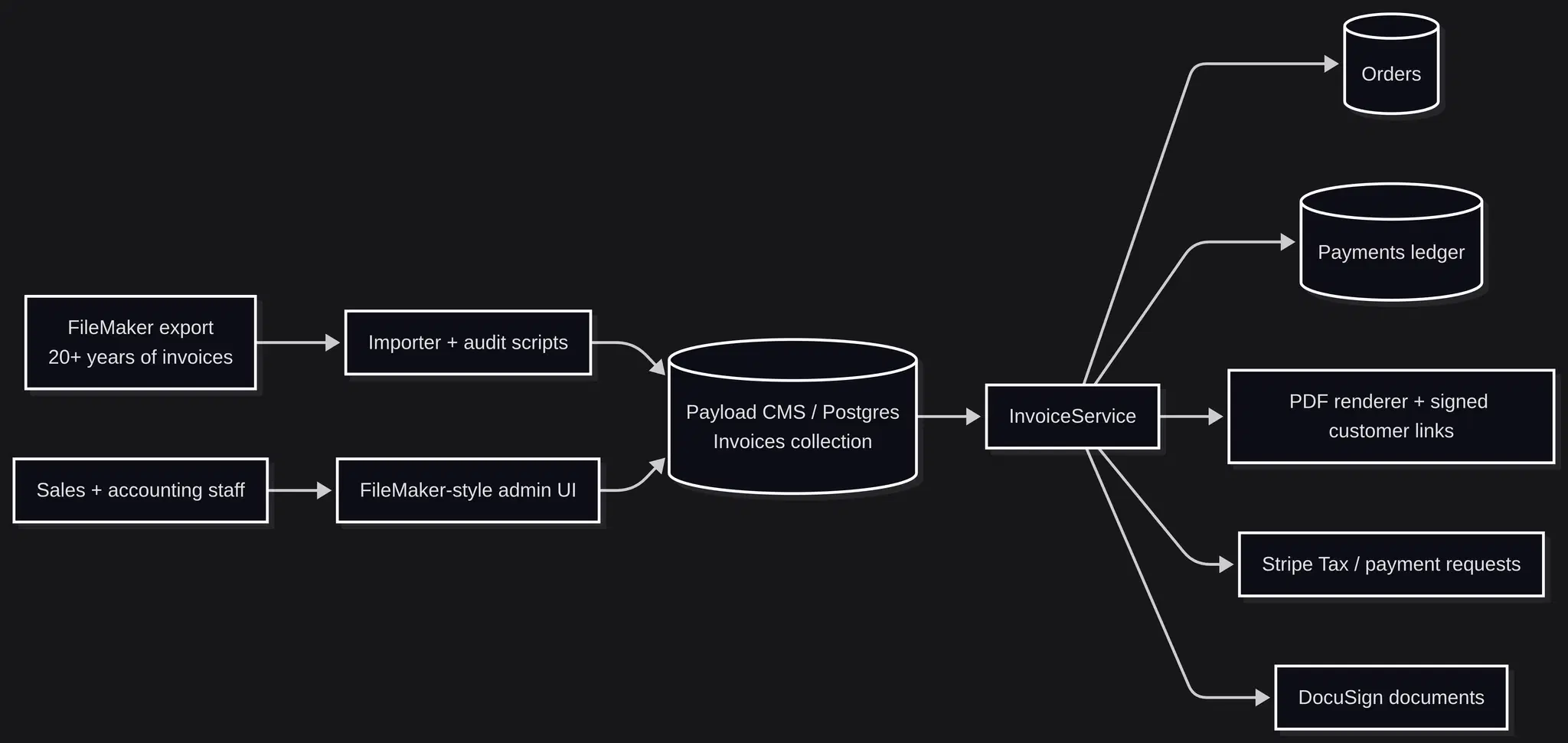
Architecture overview: FileMaker export through importer + audit scripts to Payload Invoices, then through a single InvoiceService composing with Orders, Payments, PDFs, Stripe Tax, and DocuSign.
The proof is a business like yours
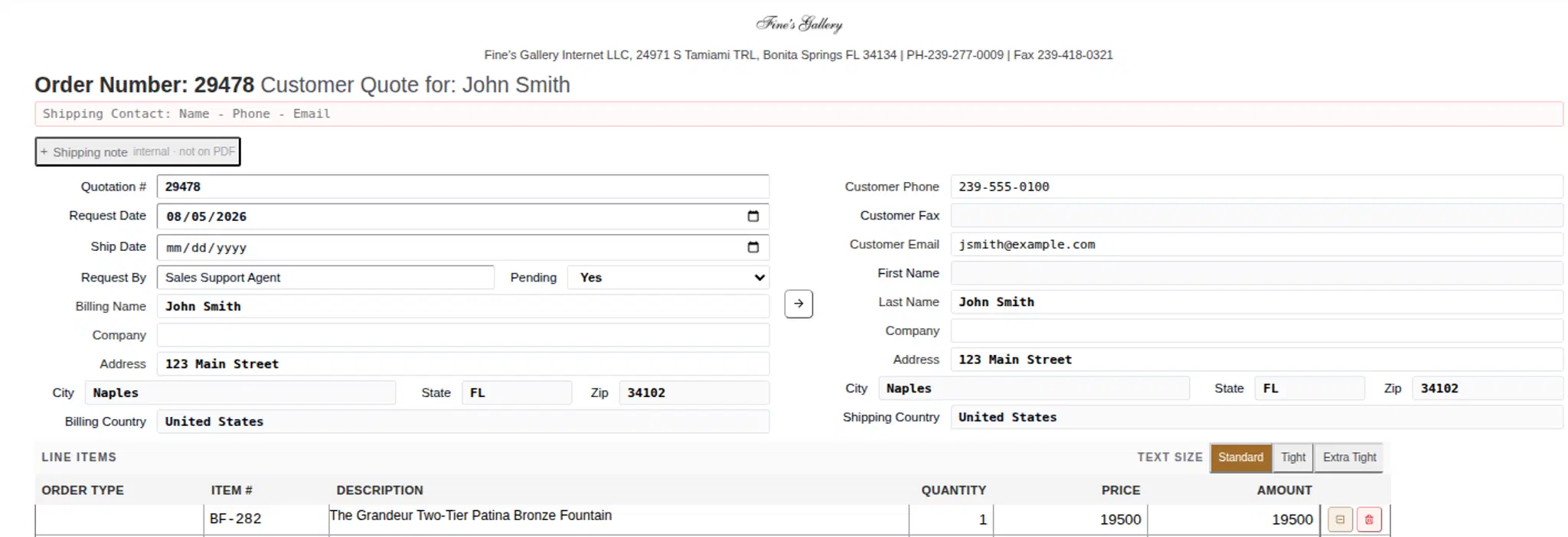
Fine's Gallery, a Bonita Springs luxury retailer, ran quoting and invoicing on FileMaker for more than twenty years. Orders routinely reach six figures; deposits, balances, wire transfers, and signed documents ride on every one. If the invoicing system broke, the business stopped. I replaced it with a platform they own: 28,062 invoices migrated with full history and continuous numbering, zero days of operational downtime during cutover, and the FileMaker workflow habits staff relied on rebuilt inside the new system rather than discarded.
That migration was not the end of the story, and this matters for the economics: the replacement became the foundation for an owned commerce platform now supporting millions in annual revenue, and later for production AI agents that work inside it. Legacy replacement done properly is not a cost. It is the first installment on a platform. The full case study documents the build; the FileMaker deep dive documents the engineering, down to the found-set navigation and the PDF fidelity.
Specializations inside this door
FileMaker replacement. The most common entry, common enough to have its own page covering the FileMaker-specific realities: found sets, scripts, layouts, printable documents, licensing costs, and the single aging server everything depends on.
Migration and rescue. Systems already mid-crisis: the migration another firm abandoned, the developer who left with the knowledge, the cloud deployment that is fragile in ways nobody can explain. Rescue work starts with stabilization and evidence gathering, then follows the same discipline: assess, rehearse, verify, cut over. The worse the situation, the more the process matters.
When I will tell you not to replace
Replacement is the expensive option, and it is not always the right one. If the system is stable, single-user, and the blast radius of its failure is small, keep it and spend nothing. If the core works but one report or one integration hurts, a targeted bridge can cost a tenth of a rebuild. If the real problem is a manual step between two systems, that is an automation task, not a platform project. The Architecture Sprint exists to make this call honestly, in writing, before you commit to anything, and some sprints end with the recommendation: not yet. I would rather lose a build than sell you one you did not need. That restraint is also why the recommendation is worth something.
Delivered to the Ownership Standard
Everything this door produces lands in accounts you own and closes against the Ownership Standard: your AWS organization, your repositories, your data, your keys, live operating documentation, and an ownership test I invite you to hold me to. The system that replaces your legacy dependency must not become a new dependency with better fonts. I can remain accountable for operating and improving it after launch, while the client keeps control of the platform and the option to change operators later.
The entry path
Start with a Platform Architecture Sprint: $15,000, three weeks. You get the current-state risk register, the target architecture, the migration plan, and the cost model, in writing, whether or not you ever hire me again. The sprint fee is credited in full against the subsequent build when I perform the build. Platform builds start at $80,000 and typically run three to six months to a rehearsed cutover with rollback criteria and an agreed downtime objective. Pricing is published, which is itself a signal worth demanding from anyone you evaluate.
Every sprint includes a vendor dependency audit: your current stack, scored in writing against the six questions and the Ownership Standard.
The approach
How a legacy replacement reaches cutover safely
Plan the migration like a regulated production change. Rehearse it. Audit it. Cut over with rollback criteria defined in advance and the legacy system still operable until the new system is proven.
Legacy system audit
Inventory the actual data, the actual workflows, the actual edge cases, and the actual users. Read the records. Talk to the staff. Find the rules that aren't written down anywhere.
Target architecture design
Specify the destination: a sovereign AWS Organization, a Postgres data model that absorbs the legacy workflow without losing the workflow, integration boundaries, observability, and the staff operating surface.
Migration plan + rehearsal
Production-clone rehearsals before any production cutover. Per-cohort phased migration with reconciliation gates. Idempotent scripts with dry-run + apply modes. Strict payment-ledger audit if money is in scope.
Cutover with rollback criteria
Defined rollback criteria, defined success criteria, defined operational owners for the cutover window. Legacy system stays operable through cutover.
Post-cutover monitoring
CloudWatch alarms, drift detection, divergence monitoring against the legacy system for as long as the operation needs the safety net. Architectural Decision Records and a runbook the team inherits.
What you receive in a legacy system replacement
- Legacy system audit + risk register: data shape, workflow inventory, integration map, staff dependency analysis, edge cases that aren't written down anywhere.
- Target architecture: sovereign AWS Organization, ECS Fargate, RDS Postgres, S3, CloudFront, SQS + Lambda backbone, KMS / IAM via GitHub OIDC. Terraform-managed.
- Migration plan with per-cohort phased ingest, reconciliation gates, dry-run + apply scripts, idempotency, rollback criteria, and strict ledger audit when money is in scope.
- Production-clone rehearsals before any production cutover. The cutover runs against the same shape of data the migration script processed during rehearsal.
- Cutover runbook with defined success criteria, defined rollback criteria, defined operational owners, and a recovery path that keeps the legacy system operable through the window.
- Staff workflow preservation: the safest migrations keep familiar operating patterns where they matter while removing the platform limits underneath them.
- Post-cutover divergence monitoring against the legacy system for as long as the operation needs the safety net. CloudWatch alarms, drift detection, observability discipline.
- Architecture Decision Records, runbooks, recovery procedures, and operating documentation kept current through cutover and any ongoing platform engagement.
FAQ
Legacy system replacement questions
The legacy system stays operable while the new platform absorbs the workflow. Before implementation, the SOW defines permitted downtime, data-loss tolerance, validation steps, rollback criteria, and operating owners for the cutover window. Fine's Gallery achieved zero operational downtime and zero loss across 20+ years of legacy operational data, but that is a reference outcome, not a blanket guarantee for every system.
Rollback criteria are defined before the cutover starts, not invented at 3 AM during the cutover window. The legacy system stays operable through cutover. Per-cohort phased ingest means a problem in one cohort doesn't take down the whole migration. The rule across every migration is the same: if the system can't prove a data movement is safe, it doesn't apply it automatically. That's why the Fine's Gallery migration deferred 12 orphan invoice deposits by policy instead of forcing them into the ledger.
The plan and the rehearsal are usually 4 to 12 weeks. The cutover itself is a defined window (often a single day or a defined off-hours run) gated by rehearsal success. Total elapsed time from engagement start to production cutover depends heavily on data volume, workflow complexity, integration count, and how many cohorts the migration runs in.
The Fine's Gallery FileMaker retirement was one of multiple migrations inside a 19-month custom platform build.
Not as the primary engagement. Lift-and-shift is usually a worse outcome than rebuilding the platform with the legacy data preserved.
If the goal is to move existing infrastructure between hosting providers without changing the workflow, an AWS Partner with that specific specialization is a better fit. If the goal is to migrate off a SaaS or legacy operational stack onto sovereign infrastructure designed around the actual workflow, that's exactly what this engagement does.
Defined explicitly. Some legacy data needs to come over (historical invoices, customer records, payment ledger). Some legacy data is local to the legacy system and shouldn't move (test fixtures, deprecated workflows, abandoned integrations). The migration plan calls out what comes, what stays, and what gets archived for compliance.
Migration plans from $15K (Platform Architecture Sprint scope: a written architecture decision document covering the current-state audit, risk register, target architecture, migration plan, and cost model, delivered in 3 weeks). Cutover engagements scope after the assessment based on data volume, workflow complexity, and integration count.
If the engagement scopes naturally as a multi-month build with the legacy retirement as one phase, it usually runs as a Platform Build starting at $80K. Ongoing Platform Engineering starts at $10K per month when you want me to continue operating the AWS infrastructure and application, handle maintenance and incidents within defined coverage, and ship the next roadmap items after cutover.
Solo delivery by Peter T. Conti, AWS Solutions Architect Professional + Associate. Lead Architect on a national-scale energy-sector certificate registry migration design. Principal engineer on the Fine's Gallery FileMaker retirement (28,000+ historical invoice records migrated, strict ledger audit exit code 0, 0 duplicate invoice numbers).
The same person who scopes the migration ships the scripts, runs the rehearsals, and owns the cutover.
Usually the honest answer is that you have an operations problem, not an accounting problem, and an ERP quote solves the wrong one at six-figure cost. The pattern I build keeps your ledger where it is and replaces the workflow around it with an operations platform you own, synced to your books. If a genuine ERP requirement survives that analysis, I will tell you so in writing, and the sprint is designed to settle exactly that question before you sign anything.
Tell me about the system: what it runs, who depends on it daily, and what prompted you to look at replacing it now. Vague is fine; the sprint exists to make it precise.
Pressure-test the platform decision before you commit budget.
Schedule a complimentary 30-minute consultation to align on objectives, stress-test your architecture, and leave with a concrete set of recommendations. No obligation, no sales pitch. Just actionable technical guidance.