A Payload CMS social media plugin can call platform APIs in a few lines. Running a publishing operation a business depends on is the harder problem: four incompatible API dialects, asynchronous pipelines that fail ambiguously, per-platform rate limits, token lifecycles, and the worst failure mode in this domain: the same post published twice in public.
payload-plugin-socials closes that distance inside Payload CMS. It publishes to Pinterest, Instagram Business, Facebook Pages, and Google Business Profile from one panel: compose, preview, template, schedule, publish, reconcile. It was built to run organic social publishing for Fine's Gallery, a luxury bronze and marble retailer with nearly one million annual users, and it is now open source under MIT, with zero runtime dependencies and 1,146 tests.
It is also built to be operated by an AI agent. Every capability exposed to a human is available to a governed agent through the same validated, idempotent, audited surface. The clip below is a production operations agent composing and publishing to three platforms from live catalog records:
What the Payload CMS Social Media Plugin Provides
Installation adds two collections (posts and templates), one hidden global holding encrypted platform connections, five background job tasks, and a REST surface of roughly thirty endpoints covering publish, preview, validation, history, OAuth, webhooks, and account discovery. The admin experience ships in four modes: a Socials tab injected into your own collections, a standalone control center, a dashboard widget, or fully headless for worker deployments.
Platform Coverage
Pinterest (API v5, sandbox supported): image Pins and video Pins, with board discovery and creation from inside the admin. Video runs Pinterest's register, upload, and poll handshake with streaming multipart transfer, so a two-gigabyte file never buffers inside the CMS process.
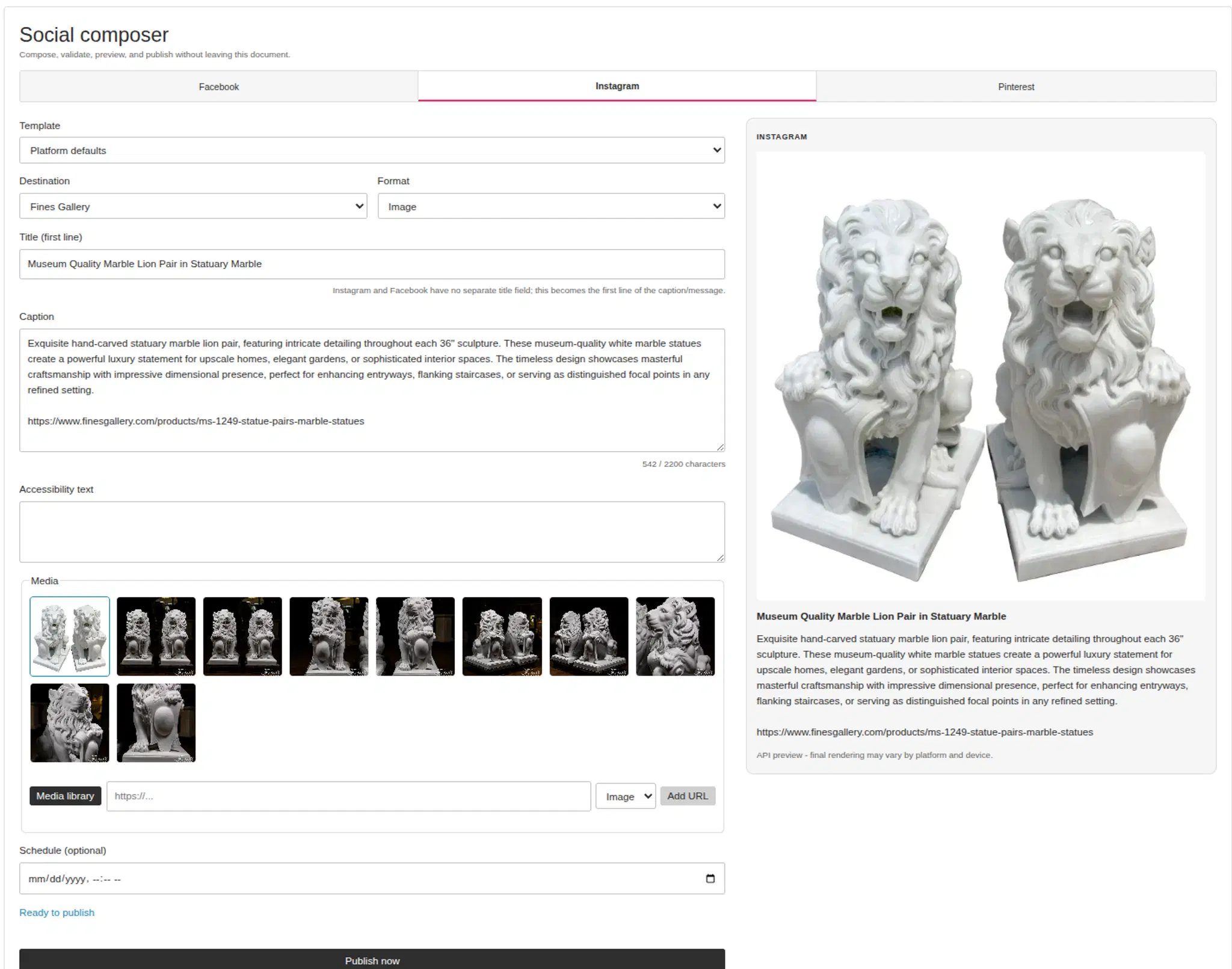
Instagram Business (Graph API v25, pinned and configurable): single images, Reels, Stories, and carousels up to ten items through Instagram's asynchronous container pipeline. The plugin creates the container, polls its processing status, and publishes when Instagram reports it ready. Single videos ship as Reels, because the plain video type is being phased out platform-side.
Facebook Pages: link posts, single photos, multi-photo posts assembled from unpublished children, and video. Scheduling is either plugin-side or handed to Facebook natively, which holds the post from ten minutes to seventy-five days out.
Google Business Profile: standard, event, offer, and alert Local Posts, so the profile beside a map listing stays as current as the feeds. Auth supports OAuth or a service account with impersonation. This adapter is API-complete and contract-tested, and the README labels it experimental until it has run a live canary.
Templates and Composition
Content never leaves the CMS to get published. A source resolver, written once, maps any collection to publishable content: products, posts, promos, events. Templates are documents in their own collection, bound to a source kind, with per-platform variants and token interpolation over that collection's fields. A live preview renders the exact output for a chosen record while the template is being edited, so the template is verified against real data before it is ever used.
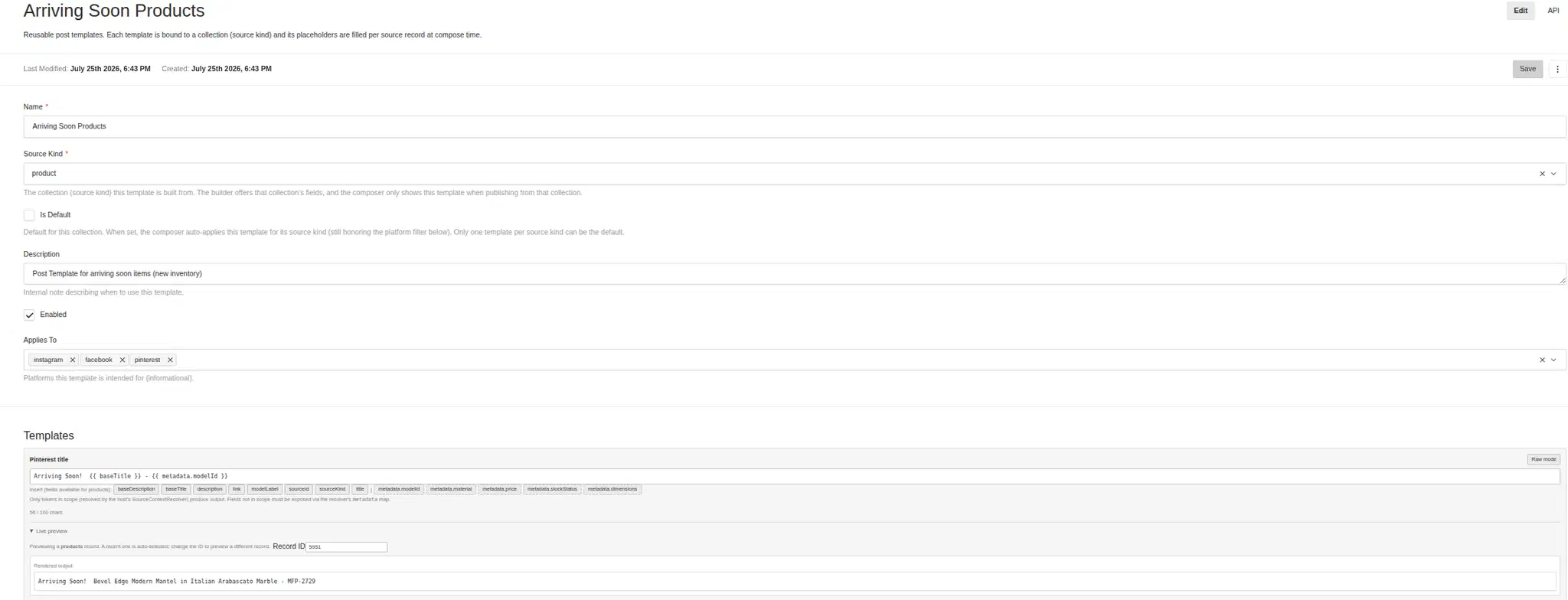
On the document itself, the Socials tab applies that template and fills it from the record. Each platform gets its own tab, its own format selection, and its own rendered preview of what will actually appear. A compose call can fan one document out to several platforms at once with per-channel error isolation, so one failing platform never blocks the others.
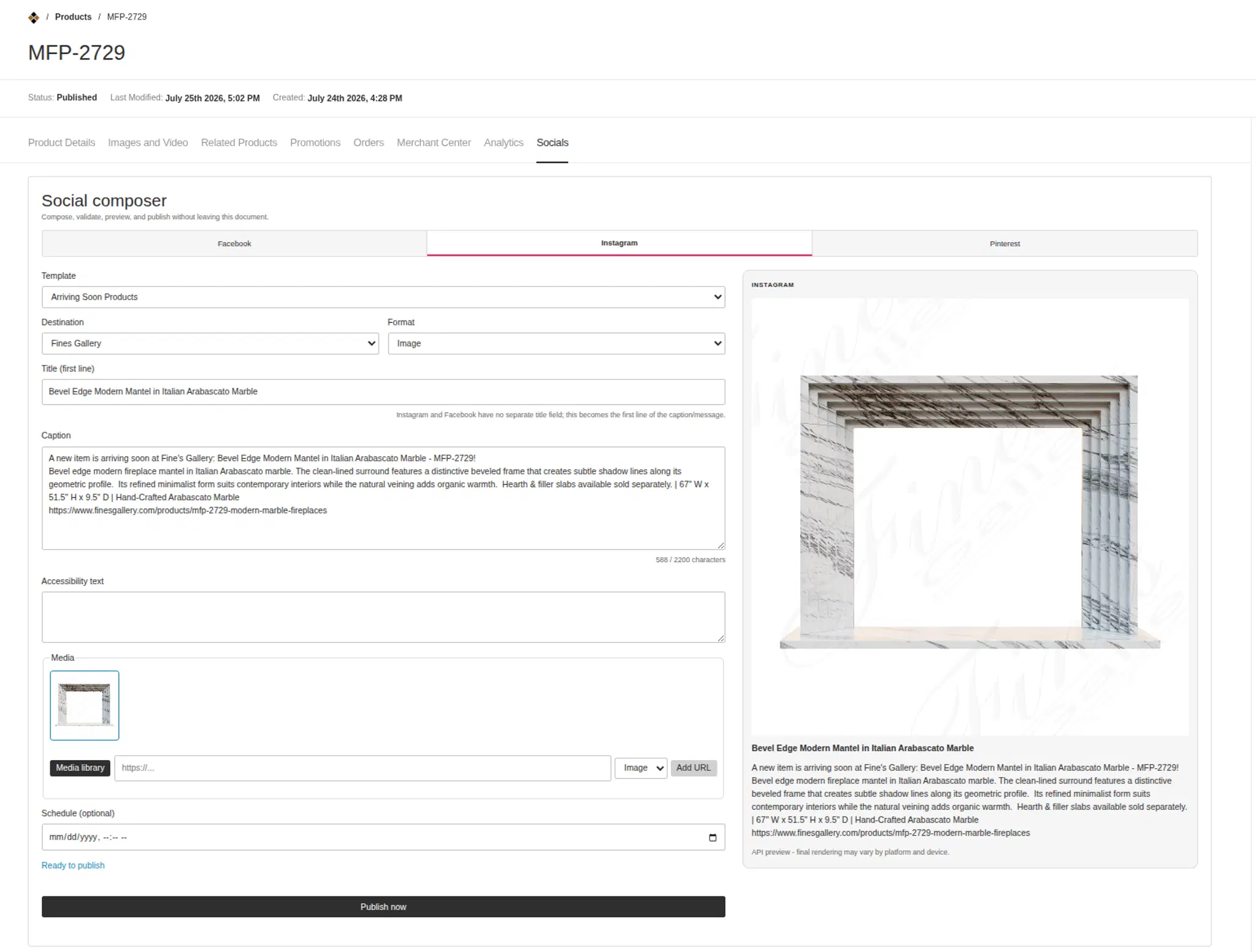
Validation runs on the server before the request leaves it. The constraint tables encode each platform's published rules: Instagram accepts JPEG only within an aspect band, with caption and hashtag caps; Pinterest requires at least 600 pixels of width under 20 MB; Google enforces both a size floor and a ceiling. Formats are detected from the file's actual bytes rather than its URL, so extensionless CDN links work and unrecognizable files fail closed. Where a problem is fixable, automatic image conversion fixes it in flight, and the converted file never contaminates the post's identity.
Scheduling and Job Execution
Scheduled publishing runs on Payload's jobs queue, and the plugin never modifies queue configuration. There are three interchangeable ways to drive it: Payload's own job scheduler, an external cron calling the plugin's authenticated internal endpoints, or a worker process calling the sweep functions directly. The Fine's Gallery deployment uses the second, driven by an AWS EventBridge rule. Reschedules and cancellations are safe against workers already holding the previous job.
Account Connections and Token Storage
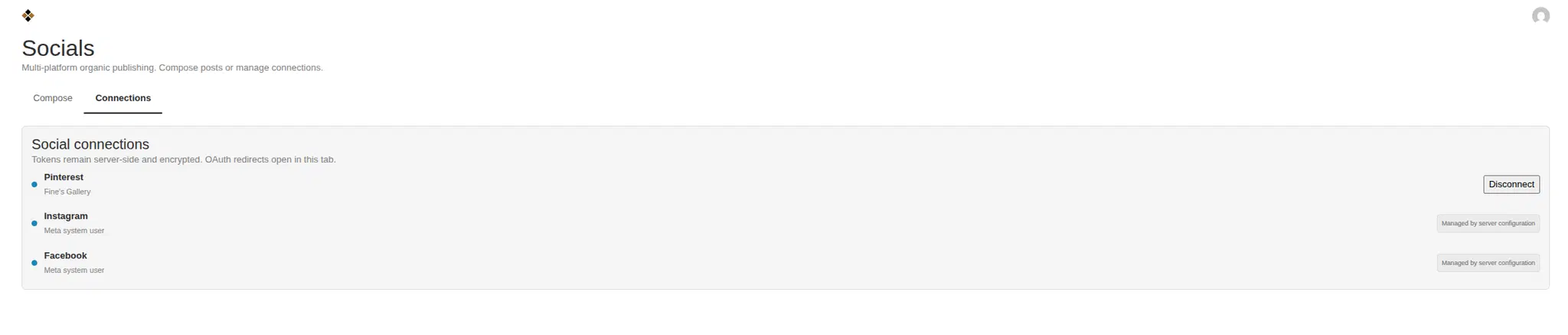
Connections are managed in the admin. OAuth flows run per platform, and discovery endpoints list available Facebook Pages, linked Instagram accounts, Pinterest boards, and Google locations, so destinations are selected from a list rather than transcribed from four developer consoles. Tokens are stored as AES-256-GCM envelopes in a hidden global and support keyring rotation: rows encrypted under a previous key are re-encrypted under the current one as they are touched. Meta system-user tokens, long-lived user tokens, and Google service accounts are all supported.
Architecture for Reliable Social Publishing
The feature surface is table stakes. What makes the plugin usable in production is its behavior when something goes wrong, which with social APIs is routine.
Exactly-Once Publishing
Every publication derives an idempotency key from what it is: platform, source document, destination, format, and primary asset URL. Deliberately not from the copy, so correcting a typo and republishing updates the same record instead of creating a duplicate Pin. A unique database index on that key is the hard guard, and the posts collection refuses direct writes; every row moves through the service layer.
Claiming a post for publishing is a compare-and-swap built on a conditional update: set the row to publishing where its status is still claimable, and if zero rows come back, another worker won the race and this one exits with a conflict. No lock server is required, and the behavior is identical on Postgres and MongoDB because the database's own atomicity does the work.
The strictest rule governs ambiguity. When a platform accepts a request but the response is lost, retrying is how a duplicate reaches the public. An ambiguous write is therefore never retried: the post parks in an explicit unknown state, automatic machinery refuses to touch it, and a resolve endpoint requires a human to confirm whether the provider published it. Rescheduling uses the same discipline through revision tokens, where a worker holding a stale token reports itself superseded rather than publishing. Job cancellation is an optimization; the token is the correctness fence.
Platform-Specific Behavior
A production integration is mostly accumulated platform knowledge. Meta returns HTTP 200 with an error embedded in the body, so both are inspected on every call. Request signing rides as a query parameter, because Meta's parser misses it in header-only mode for some body encodings. Expired tokens are identified by error code and subcode, invalidated, and re-exchanged once. Throttling is classified by Meta's own error codes, including the business-use-case band, rather than by HTTP status. The client parses Meta's usage headers and warns at 75 percent of quota. Instagram's container states map to four distinct outcomes with four distinct retry behaviors, and Pinterest's Retry-After header is honored whether it arrives as seconds or as an HTTP date.
Defense in Depth
Every provider call passes a dual-layer limiter: bounded concurrency and a sliding sixty-second window, scoped per platform and per operation class, so a video upload cannot starve ordinary API calls. The wait queue is capped, which converts backpressure into a clean 429 rather than unbounded memory growth. Fetching remote media is treated as the server-side request forgery surface it is: HTTPS only, thirty-one blocked special-use IP ranges, every redirect hop re-resolved and re-validated, and the socket pinned to the exact validated address while preserving the hostname for TLS verification, which closes the DNS-rebinding window. The logger redacts secrets by key pattern and by value shape for every token format the four platforms use, and every log call is isolated so that a logging failure cannot change a publishing outcome.
Built to Be Driven by AI
The plugin contains no model calls and no bundled agent. That is a recorded architecture decision. What an agent requires is not AI inside the tool; it is a governed tool surface: strict validation returning structured, fixable errors; draft-first flows where publishing is a separate deliberate step; idempotent writes that make a confused retry harmless; and audit rows that make every action attributable. Those properties were built for human operators, and they are the same contract that makes agent operation safe.
The second video above shows that contract in production: the operations agent documented in the Fine's Gallery AI operations case study composing and publishing across three platforms from live catalog records, with a human approving every write. The repository ships an agent integration guide with a reference tool wrapper and a policy template. Deploying that class of governed system inside a client's own AWS account is the client-owned AI engineering practice.
Testing and Release Discipline
The plugin is roughly 20,600 lines of source and 16,700 lines of tests: 1,146 tests across 95 files, running in about a second and a half because providers are faked at the HTTP boundary. Coverage is gated in CI, which boots the suite against real Postgres 17 and MongoDB 8 containers, runs Node 22 and 24, and drives Playwright journeys across Chromium, Firefox, and WebKit with an accessibility assertion that must return zero violations. Releases pass a single gate chaining format, lint, types, coverage, build, a packed-tarball smoke test, publint and are-the-types-wrong verification, and a production dependency audit, then publish to npm with provenance attestation.
Two design consequences are worth stating. Runtime dependencies are zero, and everything except Payload itself is an optional peer, so a headless worker install pulls in neither the admin UI nor sharp. And the plugin continues to register its schema when disabled, so running a migration generation with the plugin switched off cannot produce a migration that drops the publish history.
Install the Payload CMS Social Media Plugin
Install with pnpm add payload-plugin-socials. Configuration requires four things: an encryption key, an authorization callback, a resolver mapping documents to publishable content, and credentials for the platforms in use.
import { buildConfig } from 'payload'
import { payloadPluginSocials } from 'payload-plugin-socials'

export default buildConfig({
  plugins: [
    payloadPluginSocials({
      encryptionKey: process.env.SOCIALS_ENCRYPTION_KEY!,
      authorize: async ({ req, scope }) => {
        const role = req.user?.role
        if (!role) return false
        return scope === 'admin'
          ? ['admin', 'owner'].includes(role)
          : ['admin', 'owner', 'editor'].includes(role)
      },
      sources: {
        entry: async ({ payload, id }) => {
          // map your document to a SocialSourceContext
        },
      },
      admin: {
        injectInto: [{ collection: 'content', sourceKind: 'entry' }],
        mode: 'both',
      },
      platforms: {
        pinterest: {
          clientId: process.env.PINTEREST_APP_ID!,
          clientSecret: process.env.PINTEREST_APP_SECRET!,
          enabled: true,
          redirectUri: `${process.env.PUBLIC_URL}/api/socials/pinterest/oauth/callback`,
        },
      },
    }),
  ],
})
Then generate types, generate the import map, and create and run one migration. The plugin never creates or runs migration files itself.
Production Social Publishing Results
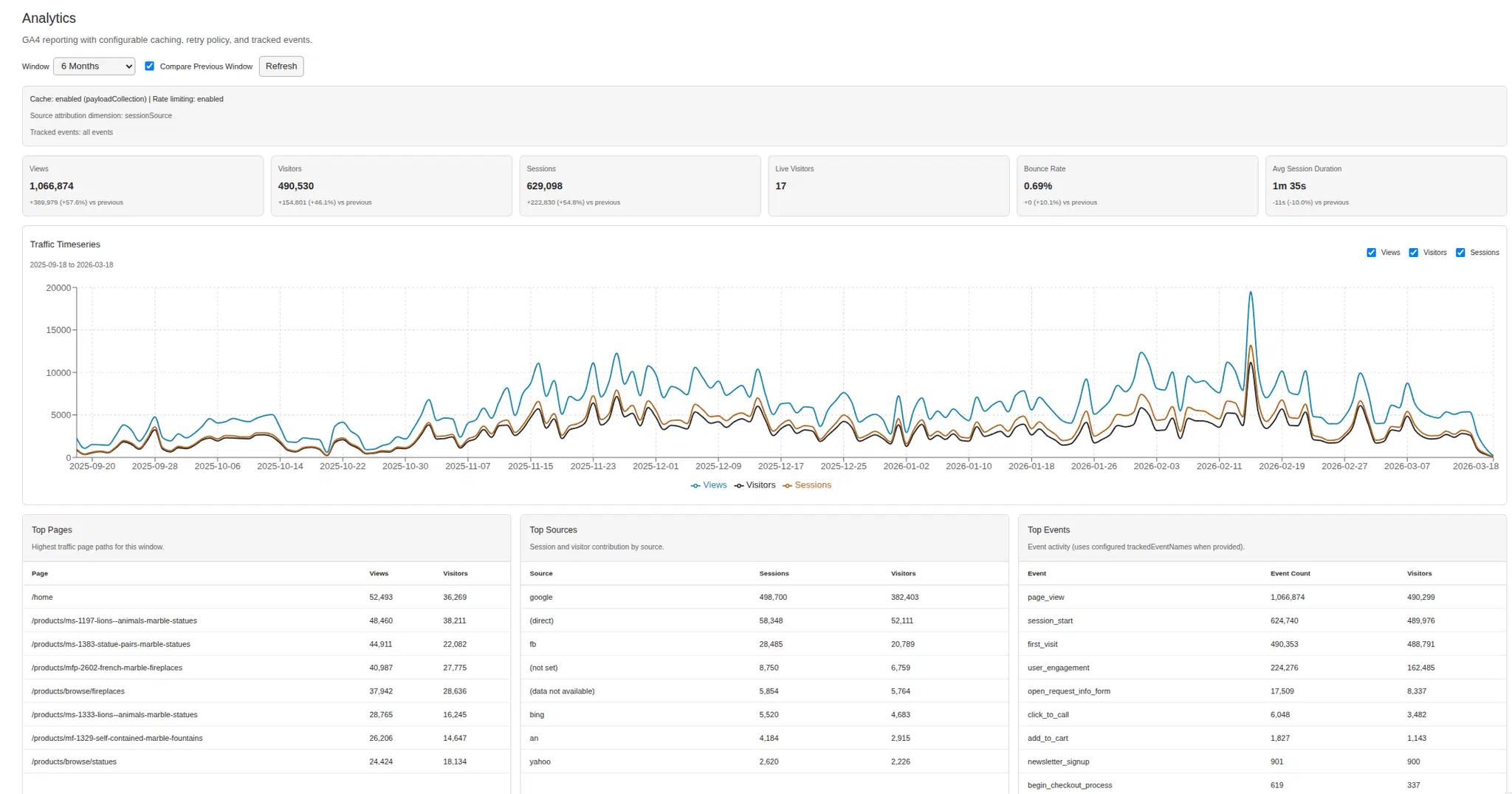
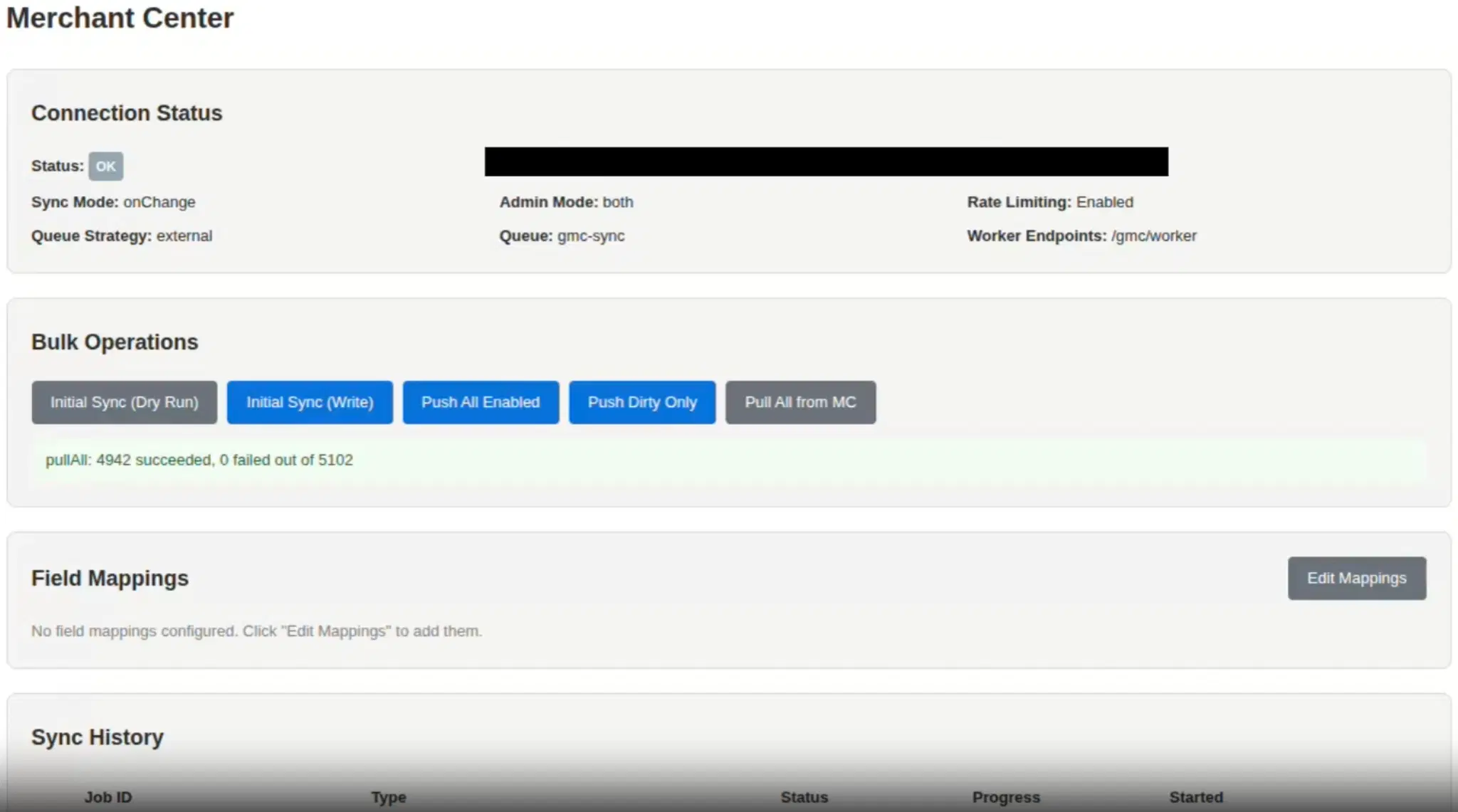
Pinterest, Instagram, and Facebook publishing run in production at Fine's Gallery against a catalog of more than five thousand products, scheduled by EventBridge as described above. This is the third plugin extracted from that platform, after the GA4 analytics plugin and the Google Merchant Center sync engine. The pattern is the same each time: build it for a real business, harden it in production, then release it.
It is on npm and on GitHub under MIT. Across all three plugins the same distinction holds: an integration calls an API, and infrastructure keeps working when that API has a bad day.