Every agency sells AI now, and the market has reached a point at which buyer's guides and other content exist: checklists of questions an owner should ask before hiring an AI firm. Some of the advice is genuinely good: identify who delivers the work, ask for references, ask how LLM hallucination is handled. If more buyers asked these questions, the market would be in a better place.It is recommended to interpret such content from the perspective of the company authoring it. Most companies assume a single delivery model: the vendor owns the runtime and bundles infrastructure, operation, and continued development into a single monthly retainer. The problem with this is not paying for ongoing engineering and system improvement: production systems require this, and it's something I provide. The issue is being unable to separate that work from the custody of the system.
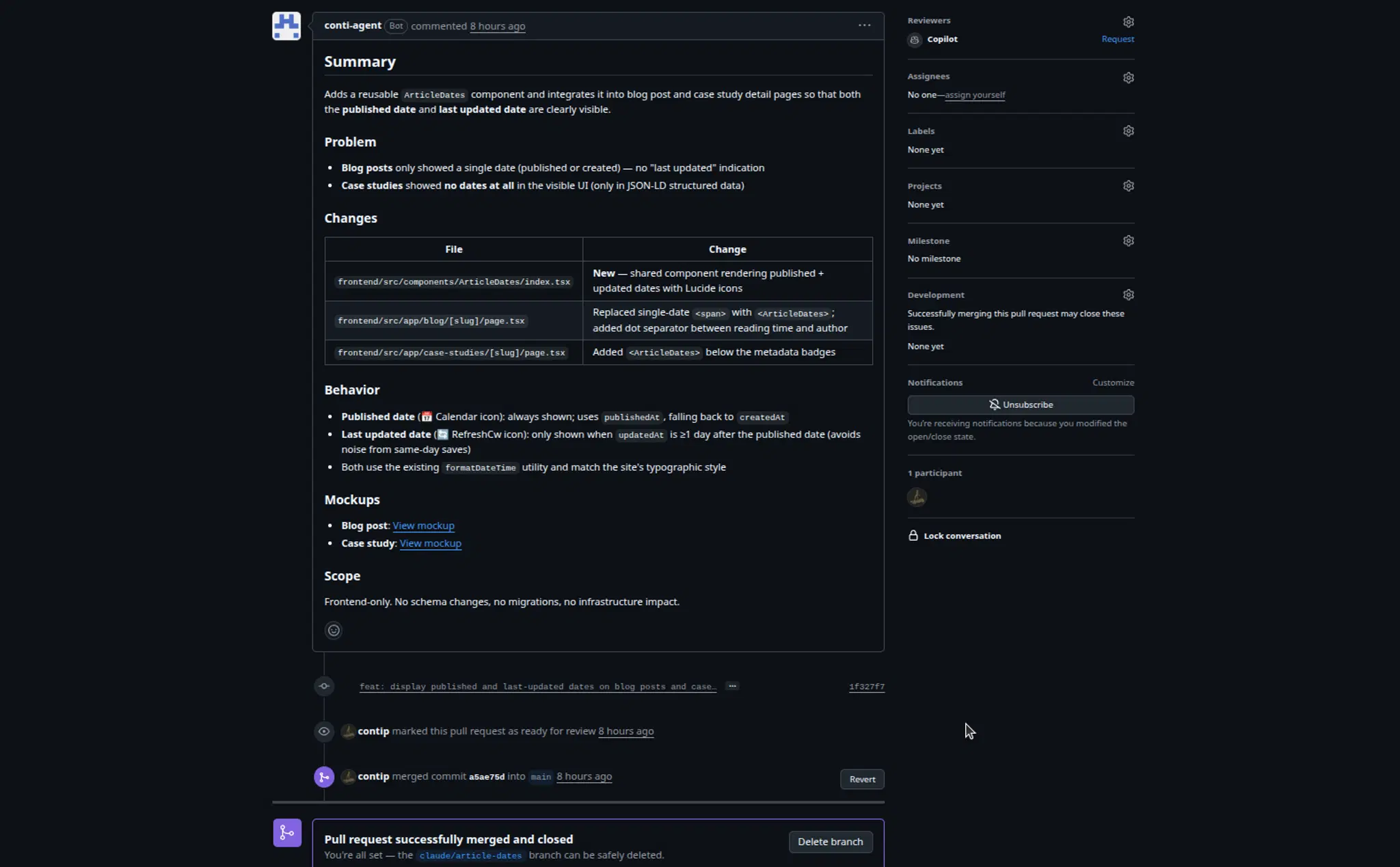
Here are six questions I believe should actually decide an AI engagement for a business that values owning their critical revenue and operations workflows, retaining sovereignty over their own data and intellectual property, and requires AI systems to touch revenue or other critical systems. Since July 2026, client-owned agents I built have been doing supervised daily work for a Southwest Florida-based national luxury retailer, inside the client's own AWS organization: read case study.
These questions outgrew this article. The maintained, vendor-neutral version, generalized to any technology engagement and released under CC0, lives at the six questions. This article stays aimed where it was aimed.
Question One: Who Owns the Account?
Ask the vendor where the agent actually runs. Not which model it uses. Which account.
Many agency AI solutions are white-label wrappers: your agent lives in the agency's tenant on a chatbot platform, under the agency's subscription, configured through the agency's dashboard. The industry openly markets this model to agencies as a way to standardize delivery and keep clients inside the agency's environment. It is an entire product category.
This question matters because account ownership is central to protecting your business workflows, data, and IP. If the solution is based on an agency's platform, then the conversation history is theirs, the configuration is theirs, the integrations are theirs, and your access exists at their pleasure. When their platform reprices due to rising API costs, your solution's economics change and you find out second.
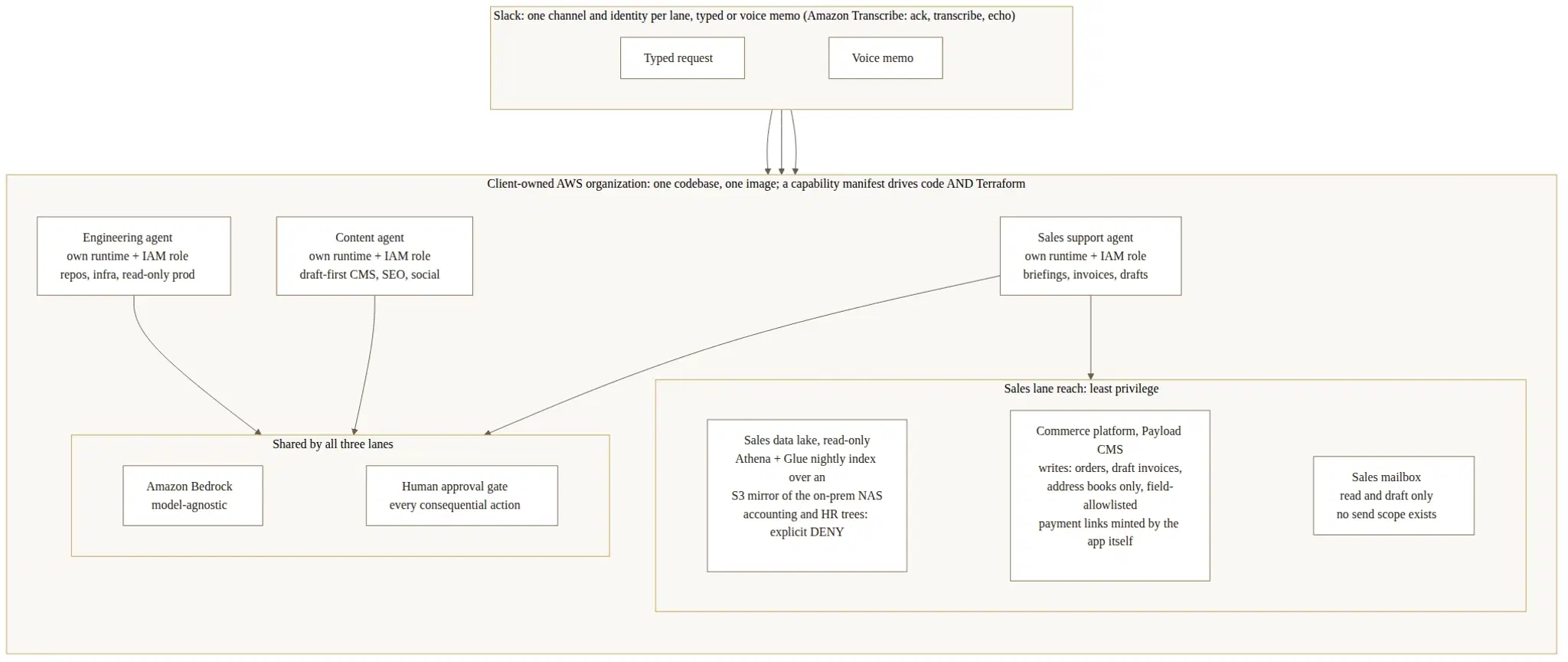
The correct answer is straightforward: the agent runs in your AWS account, inside your organization, under credentials you control. At Fine's Gallery the agents run on Amazon Bedrock in the client's AWS organization. If Conti Digital disappeared tomorrow, the agents would not notice.
Question Two: Who Holds the Keys?
The second question is about credentials, and it's where most typical agency AI offerings go from being merely overpriced, to potentially being structurally dangerous.
An agent that needs to perform meaningful work at a business in the $5M-$50M range requires access to real systems: your CMS, your CRM, your order and customer data, your repositories, your cloud resources. In an agency-managed setup, those credentials live wherever the agency put them, scoped according to their internal policies which may not be contractually guaranteed, and shared among whoever at the agency touches your account. You cannot audit what you cannot see, and you cannot see inside another company's password manager.
Question Three: What Happens When You Leave?
Vendor relationships eventually end. Pricing changes, quality drifts, the business outgrows the arrangement, someone retires. The exist is not an edge case. It is a phase of the engagement that you should be able to describe on the day you sign.
Ask a company offering managed agency-owned AI solutions what offboarding looks like and listen carefully. If the answer involves exporting your data, this can typically be translated as: the workflows, prompts, integrations, and accumulated behavior that made the solution useful stay behind, because they were never yours. Industry buyer's guides now flag this directly: undocumented prompts, tribal knowledge, and opaque agent behavior are the dominant lock-in mechanism in AI services, and silence about account and code ownership means the answer is not in your favor.
Client-owned solutions invert this exit. At Fine's Gallery, the client owns the code, the container images, the Terraform that provisions every role and permission, the approval history, and the documentation. Ending the engagement would mean ending the engagement. Their system would continue running, and a competent engineer would be able to take over operations and development, because it was built to be picked up.
That is also why I publish how these systems work in detail, in the case study and in the original architecture write-up.
Question Four: What Does the Compute Cost Versus the Fee?
Separate the infrastructure bill from the operating work.
Published AI agency pricing guides put managed retainers at four figures per month and frequently five. What does the underlying compute cost? On Amazon Bedrock, model usage is metered per token. Independent cost analysis finds teams landing 1.5 to 2 times over budget when nobody watches the meter, which is an argument for a meter you can watch, in an account you own.
The gap between those two numbers may pay for real engineering: monitoring, incident response, security maintenance, model evaluation, vendor changes, and continued feature delivery. Those are legitimate services, and I also offer them. A proposal should separate that labor from the underlying cloud / model usage bill, define capacity and incident coverage, and keep both meters visible. Vendor-only runtimes typically achieve the opposite: they make the infrastructure cost opaque and turn continued payment into the condition for keeping the system at all.
Question Five: What Changes After Launch, and Who Owns It?
Production AI systems require ongoing work. Models change, dependencies age, APIs move, permissions drift, staff workflows evolve, and incidents occur. Keeping the original builder involved can be the most efficient operating model, as that engineer already understands the decisions and failure modes. Ask what the monthly work includes, what incident coverage means, where the operating records live, and whether ending the service changes ownership of the solution.
If the original builder's continued involvement is a requirement to continue operating the system, this should be identified as a critical risk for developing a disadvantageous lock-in relationship. With that being said, a typical business owner may not have, or may not want to have, the engineering staff required to maintain modern solutions on cloud infrastructure. I do not disappear after delivering solutions, unless the business expressly hires me to deliver a solution intended to be managed and operated by their internal team at handoff. I offer a variety of continued engineering support and technical leadership services to support client-owned projects, and prefer long-standing business relationships (as they tend to be the most fruitful). The critical distinction is this: if a client relationship with Conti Digital ever ends, all of the solutions remain in-place and operable. I do not rent outcomes to my clients, I provide real, permanent business assets.
Question Six: Can You Verify the Work at the Depth You Are Buying?
Some content instructs the reader to count case studies and distrust firms without a long logo list. Counting measures marketing output and superficial breadth. A better question to ask is, can you verify these engagements - even a single one - at sufficient depth?
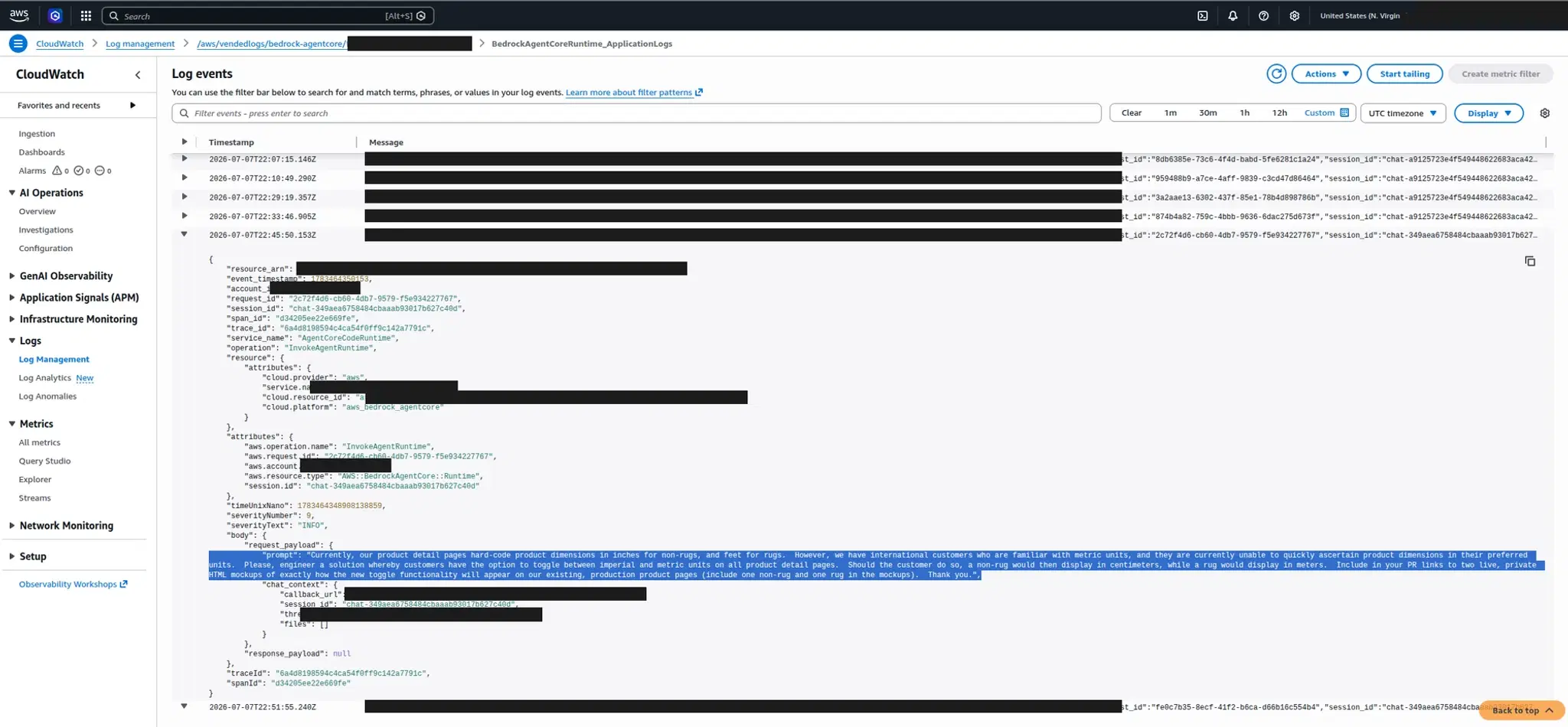
Apply it to this practice. A detailed, technical platform case study, an AI operations case study, video of the agents working, and open-source code from the same platform published on npm where you can inspect it. Then ask where the audit trail lives. A decision log inside a vendor's tenant is a log you lose the day you leave. An audit trail that cannot survive offboarding is theater. An auditable engagement beats any number of logos you cannot.
The One-Minute Vendor Test
If you care about protecting your workflows, data, and IP, and owning your own solutions, ask these six questions when evaluating any vendor selling AI solutions:
- Who owns the account? Acceptable: it runs in your cloud account, in your organization. Not acceptable: our platform, our tenant, our dashboard.
- Who holds the keys? Acceptable: scoped IAM roles you can read, approval gates on consequential actions, credentials issued per capability. Not acceptable: trust us.
- What happens when we leave? Acceptable: you keep the code, the infrastructure definitions, and the documentation, and the system keeps running. Not acceptable: we will export your data.
- What does compute cost versus the fee? Acceptable: the meter is in your account and you can see it. Not acceptable: it is included, do not worry about it.
- What changes after launch, and who owns it? Acceptable: the operator names the maintenance, evaluation, monitoring, incident, and delivery work, defines coverage, and keeps the operating record in your account. Not acceptable: an undefined promise of continuous tuning.
- Can we verify the work at depth? Acceptable: a documented production system with named technology and an audit trail in your account. Not acceptable: a logo wall.
A vendor with good answers will enjoy this conversation. A vendor with bad answers will call the questions technical details. They are not details. They are the difference between buying an asset and renting a liability with your logo on it.
Where This Leaves a $5M to $50M Business
If your operations run on high-value transactions and complicated workflow knowledge, the standard for AI in your business should be the same standard you would apply to your commerce platform or your bookkeeping: you control it, you can audit it, and you know who is responsible for operating it. That standard is not esoteric: it's met today, by a deliberately straightforward architecture: agents in your cloud account, least-privilege roles defined in code, and human approval on consequential actions.
I design and build these systems and fixed-scope engagements for luxury retail and high-value services businesses in Southwest Florida and nationwide. Start with the client-owned AI agents service page, read the production case study, and if the six questions above are questions you want answered about your own operation, book a 30 minute consultation.