
How much does an AI agent cost?
Three AI agents run operations at a luxury retailer in Bonita Springs. They draft invoices, publish to four social platforms, ship code changes, and search decades of company records. Last month the model bill was $109.71, and the forecast for this month is $260.
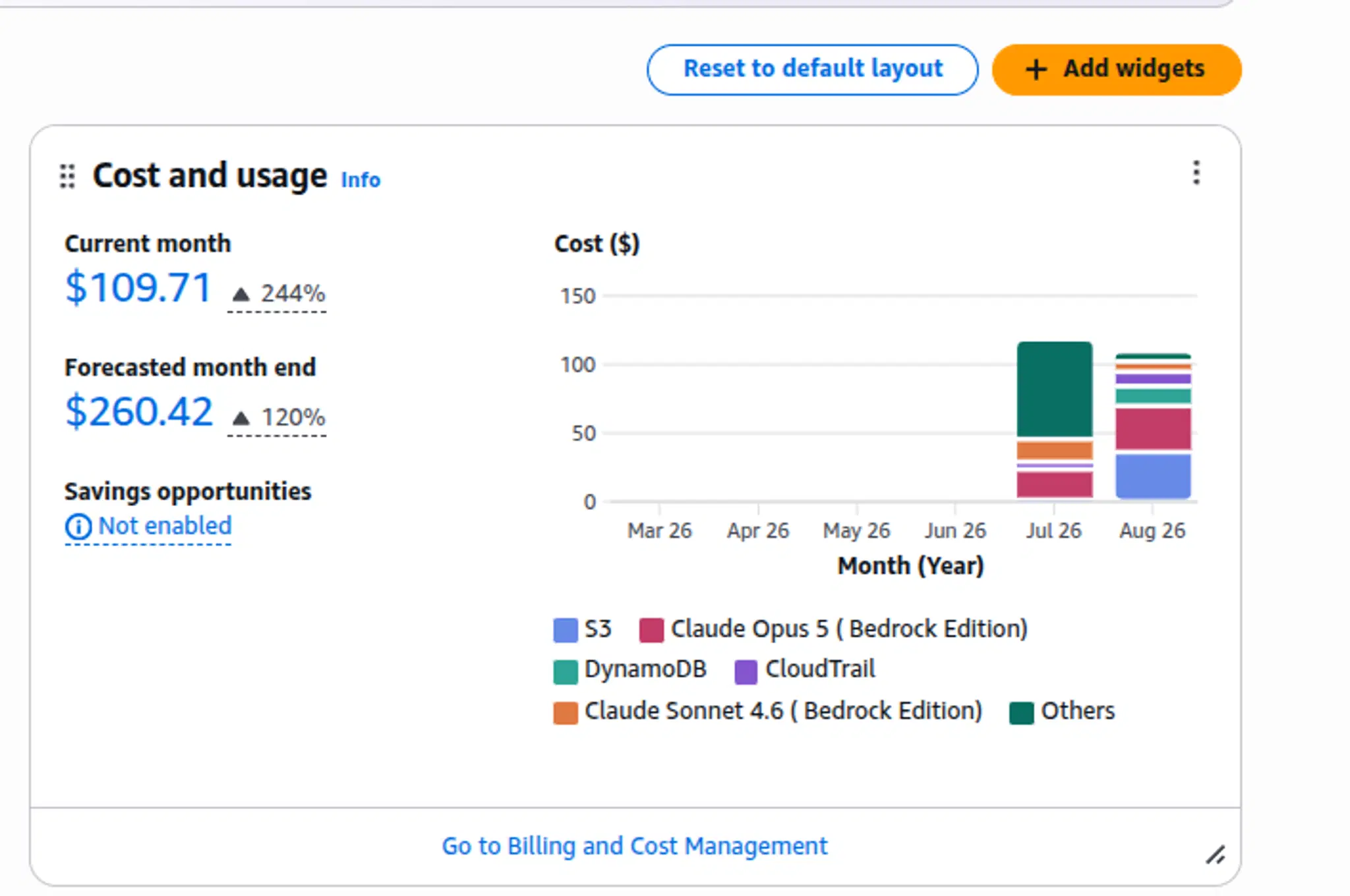
I'm publishing that number because most pricing models in this industry are built on you not seeing it. I should also say upfront that I sell one of the models below: I build systems clients own and I operate them afterward.
The part everyone quotes
Ask what an AI agent costs and you'll get a monthly figure. SaaS tools run $20 to $500 a month. Low-code platforms want a few thousand up front plus a subscription. Managed retainers in this region run four figures monthly, often five, with setup fees on top. A build like mine starts at $10,000 for the architecture sprint and $25,000 for production.
Those numbers are all real, and they're all answering a different question than the one you asked, because none of them tell you what the thing costs to run.
The part almost nobody publishes
An AI agent's actual operating cost is metered. On Amazon Bedrock you pay per token at published prices, the same prices anyone pays. That's the complete utility bill.
For three supervised production agents doing real daily work at a mid-market business, that bill has run between roughly one and three hundred dollars a month, on the most expensive model tiers available, with the system not yet at full volume. It will grow as usage grows, and it should: that is the entire point of having the meter.
The number matters less than where it lives. My client can open their own billing console and see it itemized by model and by day. When it moves, they can ask why, and we can do something about it.
Here's what that looks like in practice. The sales agent searches a mirror of decades of company records. The obvious way to build that is a vector database on OpenSearch, which carries roughly a $345 monthly floor before a single query runs. We used a nightly index queried over plain S3 storage instead: pennies per query, no idle floor, no vector database on the bill at all, as the workload simply did not require one.
That decision only happens when the person designing the system is also accountable for what it costs to run. In a vendor's account, both the decision and the bill are invisible to you.
The part that's genuinely expensive
Compute isn't the real cost. Designing and building the thing is, and operating it after launch is.
Somebody has to maintain it, patch it, add features, and answer the phone when it breaks at eleven at night. That's real money in every model, mine included.
The difference isn't that ownership is free. It's that ownership separates the meter from the labor. You can see what the compute costs, you can see what the work costs, and you can shop each one independently: hire me, hire someone else, hire nobody for a quarter. Bundle them into a single monthly number and you lose the ability to tell which one you're actually paying for.
The arithmetic, once
One bounded operations agent, built to own: $35,000 to $45,000 in year one including the sprint, then a few thousand a year to run. The same capability as a managed service: $2,000 to $8,000 a month. The lines cross somewhere between month five and month twenty and at the crossing, one of you owns a system and the other owns a receipt.
Where it gets closer is continuous work. If you're adding agents across sales, operations, and content for years, an embedded team's monthly fee buys real labor, and so does mine. The annual spend can land in a similar place. The difference is what's left behind: one model accumulates infrastructure, code, and documentation that keep running if you pause; the other accumulates a dependency that resets to zero the day the engagement ends.
The question worth asking
Service labor has value. Monitoring has value. Somebody being reachable at 2am has value. The question isn't whether the fee is large, it's what the fee buys: new work and accountability, or continued access to something you can't take with you.
Buy the asset. Then pay qualified people to support and improve it.